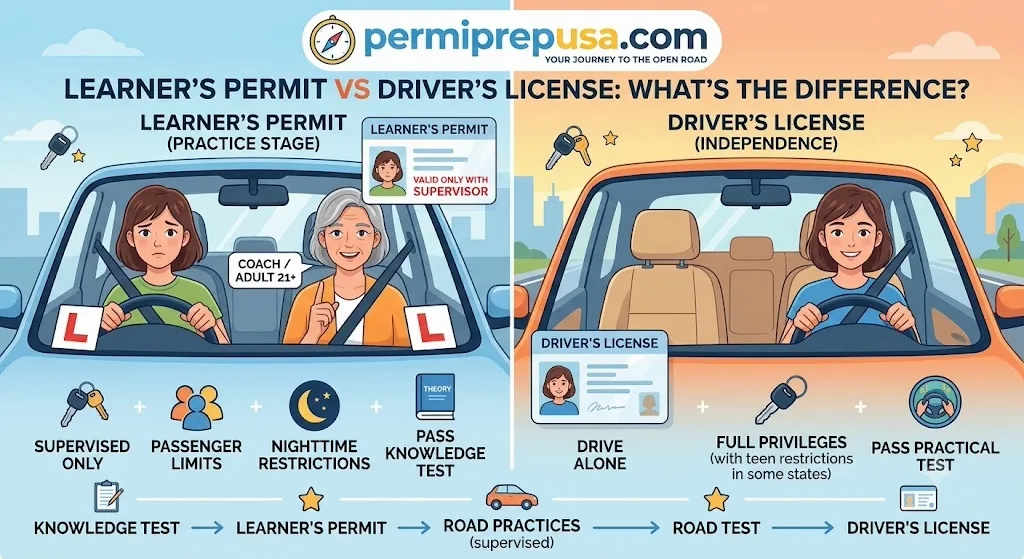
The Examiner’s Direct Answer: The Two Pillars of Licensing
Quick-Answer Box: The fundamental difference between a learner's permit and a driver's license comes down to **independent operational authority**. A learner's permit is a restrictive training credential that **strictly prohibits driving alone**, requiring a qualified, licensed adult supervisor in the front passenger seat at all times. Conversely, a full driver's license grants you unrestricted legal authority to operate a motor vehicle **completely independently**, travel at any hour, and carry passengers without supervisor vetting.
Every week at my desk, I see the complete shift in an applicant's demeanor when they transition from a permit to a license. When they have a permit, they look like a student—carefully carrying folders of paperwork and secondary IDs. But the moment they pass their physical road test and I hand them a full driver's license, their body language changes entirely. They are no longer a student; they are an independent operator.
While the physical cards look almost identical, the legal definitions, statutory boundaries, and operational rights of these two milestones are worlds apart. Mistaking the rules of a permit for the privileges of a license is one of the most common ways novice drivers land massive traffic citations at our counters.
As a DMV examiner, I want you to understand exactly where you stand in the state system. Let's deconstruct the structural differences between a permit and a license, compare their restrictions side-by-side, and outline how to transition seamlessly from one phase to the next.
Side-by-Side Comparison: Permit vs. License Matrix
To give you a definitive view of how the state separates these two milestones, I have organized the core operational rights into a clean, mobile-optimized reference table. This chart maps the structural parameters you face during each individual phase.
| Operational Feature | Learner's Permit Phase | Full Driver's License Phase | |
|---|---|---|---|
| Independent Driving | Strictly Prohibited: Driving solo is a misdemeanor offense. |
Fully Authorized: You can operate the vehicle completely alone. |
Fully Authorized: You can operate the vehicle completely alone. |
| Front Seat Passenger | Mandatory Supervisor: Requires a licensed adult (usually 21+ or 25+). |
No Vetting Required: No supervisor or passenger monitoring necessary. |
|
| Nighttime Curfews | Strictly Enforced: Banned from late-night blocks (e.g., 11 PM to 5 AM). |
Completely Exempt: You have the legal right to drive 24/7. |
|
| Testing Milestone | Written Knowledge Exam: Requires clearing the randomized computer kiosk. |
Physical Road Test: Requires a behind-the-wheel skill evaluation. |
The Learner's Permit: A License to Practice
As we have deconstructed throughout our foundational guides, a learner's permit is exclusively an educational credential. The state issues it to prove that you have passed your automated computer evaluation—matching the scoring benchmarks we outlined in what score do you need to pass the DMV permit test—and that you possess the theoretical background to safely begin physical training.
However, the permit carries severe systemic limits. You are completely bound by the strict GDL frameworks, passenger caps, and zero-tolerance mobile device rules we mapped out in our breakdown of learner's permit restrictions every teen should know.
If you break those parameters by driving alone, law enforcement will treat you exactly as if you have no license at all, triggering the immediate vehicle impoundments and timeline resets we deconstructed in can you drive alone with a learner's permit.
The Driver's License: Full Legal Autonomy
A full driver's license is an unrestricted legal right. It certifies that you have completed your mandatory training hours, served your structural holding windows, and successfully proven your practical skills during a live behind-the-wheel examination with an examiner like me.
Once you hold a license, the administrative chains are cut:
- You can commute to work or school at 3:00 AM without worrying about curfew scripts.
- You can road-trip with a car full of friends without needing an adult supervisor vetting your passenger log.
- Your identification is globally recognized as a definitive, high-tier validation document.
However, this independence carries a massive spike in liability. As a licensed driver, any mistakes you make—speeding, running traffic signals, or causing accidents—will instantly attach to your permanent driving abstract. This directly impacts your insurance premiums and can lead to a rapid accumulation of points, triggering administrative suspensions.
The Progression: How to Graduate from Permit to License
You cannot simply buy your way from a permit to a license; you must earn the transition through strict compliance. If you are currently holding an active permit, you must execute three clear steps to clear the graduation gates:
1. Manage the Expiration Timeline
Never let your permit sit in a drawer. As we detailed in our guide on how long is a learner's permit valid, these credentials carry a strict one-year countdown in most states. If you let the card expire before booking your road test, your previous written test credit is wiped out, and you must start over.
2. Log Your Hours Honestly
Do not shortcut your behind-the-wheel training. Most states mandate 50 full hours of practice. If you try to guess your way through real-world traffic maneuvers without this foundation, your lack of preparation will be instantly obvious to the examiner grading your road test.
3. Understand the Stakes of Failure
If you fail your physical road test, you will face mandatory cooling-off periods and retesting fees, similar to the administrative loops we deconstructed in can you retake the DMV permit test if you fail and what happens if you fail the DMV permit test. Respect the evaluation, treat your practice phase like a serious legal job, and the transition will be a seamless success.
An Examiner's Final Piece of Advice
Whether you are a teenager entering the GDL pipeline or an adult getting behind the wheel for the first time—as we explored in can adults get a learner's permit—the journey from permit to license is a process designed to keep you safe.
Do not try to rush it or cheat the restrictions. Respect the permit phase as your foundation, build clean driving habits under proper adult supervision, and when you finally earn your unrestricted license, you will be fully prepared to handle the freedom of the road responsibly.
