The Examiner’s Direct Answer: The Golden Rule of Yielding
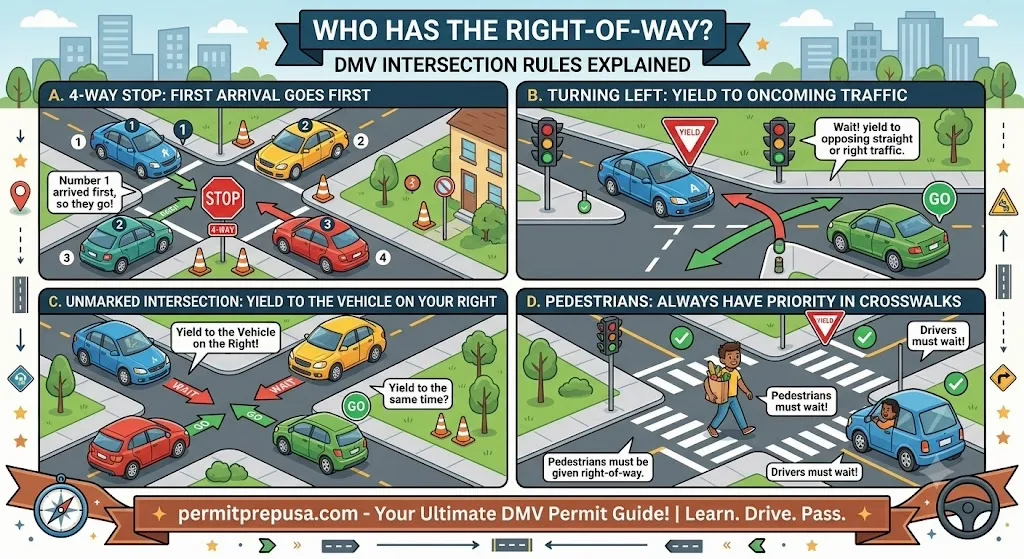
Quick-Answer Box: The most important legal concept to understand for the DMV permit test is that the law never gives anyone the right-of-way; it only states who must yield it. At a 4-way stop, the first vehicle to arrive goes first. If two vehicles arrive simultaneously, the vehicle on the left must yield to the vehicle on the right. At a T-intersection, the vehicle on the terminating street must yield to cross-traffic. Furthermore, you must absolutely always yield to pedestrians in a crosswalk, blind individuals with white canes, and emergency vehicles displaying flashing sirens.
If there is one subject that consistently devastates an applicant's score on the computerized written exam, it is intersection right-of-way laws. Every day, I watch well-prepared teenagers and adult applicants stare at a diagram on our testing terminal showing four cars at an intersection. The timer ticks down, panic sets in, and they inevitably guess the wrong answer.
When they return to my counter holding a failure slip—triggering the exact administrative penalties we discussed in what happens if you fail the DMV permit test—they often complain that intersection rules are too confusing or rely too much on "common sense." As a veteran DMV examiner, let me immediately correct that dangerous assumption. Right-of-way is not based on politeness, common sense, or aggressive driving. It is based on a strict, mathematical hierarchy of statutory laws designed to prevent thousands of pounds of metal from colliding.
Failing to understand who goes first does not just cost you a passing grade on the written kiosk; it is the leading cause of catastrophic side-impact (T-bone) collisions on American roadways. To guarantee your success on the exam and protect your physical safety during your mandatory training hours, we are going to execute a massive, comprehensive breakdown of every right-of-way scenario, deconstruct the legal definition of yielding, and establish an examiner-approved framework for passing these questions instantly.
The Core Philosophy: Yielding vs. Taking
Before we analyze specific intersection geometries, you must understand a fundamental legal trick that motor vehicle departments use to test applicants.
Many novice drivers believe that a green light or a specific road position legally "gives" them the right-of-way, meaning they can proceed blindly without checking for hazards. This is an administrative falsehood. The uniform vehicle code in almost every jurisdiction explicitly states that the right-of-way is something you must yield (give up) to prevent a collision, rather than something you physically possess.
Even if you are staring at a solid green traffic signal—which we decoded in our deep dive on how to read traffic signs and signals—you do not have the right to accelerate into the intersection if a pedestrian is still crossing or another vehicle is illegally blocking the box. If you cause a collision because you stubbornly insisted on "your" right-of-way, the state will hold you partially or fully liable. On the written exam, always look for the answer choice that prioritizes defensive yielding over aggressive taking.
The 4-Way Stop Matrix: Resolving the Standoff
The 4-way stop (also known as an all-way stop) is the most heavily tested intersection scenario on the DMV permit kiosk. It requires you to process the arrival times and spatial positions of multiple vehicles simultaneously.
To survive these questions, you must apply the state's hierarchical tie-breaker rules in this exact order:
1. The First-In, First-Out Rule
The baseline rule of a 4-way stop is chronological. The first vehicle that brings its front bumper to a complete, absolute halt behind the solid white limit line is the first vehicle legally authorized to proceed through the intersection. You must wait your turn in the exact order of arrival.
2. The Yield-to-the-Right Rule (The Two-Car Tie)
What happens if you and another vehicle approaching from a perpendicular cross-street arrive and stop at the exact same millisecond? The state utilizes a spatial tie-breaker: the driver on the left must always yield the right-of-way to the driver on the right. If the other car is to your physical right, you must keep your foot on the brake and let them cross the intersection first.
3. The Straight vs. Turning Rule (The Head-On Tie)
If you and another vehicle facing directly opposite each other arrive at the exact same time, the "yield to the right" rule does not apply because neither car is on the right. In a head-on tie, the vehicle traveling straight through the intersection holds the right-of-way over the vehicle attempting to make a left turn. If you are turning left, you are crossing the opposing traffic's lane, which legally mandates that you yield to them.
4. The Four-Car Standoff
Occasionally, the exam will present a nightmare scenario: four cars arrive at all four stop signs at the exact same time. The law does not have a perfect mathematical solution for this. In the real world and on the exam, the correct defensive action is for drivers to make eye contact, and one driver must physically wave or signal another to proceed first, breaking the deadlock and restarting the chronological sequence.
Uncontrolled and Blind Intersections
Not every intersection is governed by electronic signals or the physical stop signs we mapped out in understanding road pavement markings and lines. In rural areas or quiet residential neighborhoods, you will frequently encounter "uncontrolled intersections"—crossroads that have absolutely no stop signs, yield signs, or traffic lights.
The statutory rule for an uncontrolled intersection is identical to a tied 4-way stop: you must yield to any vehicle that is already in the intersection, and you must yield to any vehicle approaching from your right.
Furthermore, if buildings, dense trees, or parked cars obstruct your view of the cross-traffic (creating what is legally known as a "blind intersection"), you must drastically reduce your speed—typically to 15 miles per hour—and inch forward until your line of sight is clear before committing to the crossing.
The T-Intersection Mandate
A T-intersection occurs when a minor road dead-ends into a major cross street, forming the shape of the letter "T". This structural layout has a non-negotiable right-of-way hierarchy that you must memorize for the exam.
The legal framework is simple: The through street always wins. The driver traveling on the road that terminates (the bottom stem of the "T") must yield the right-of-way to all vehicles, pedestrians, and cyclists traveling on the continuous cross street (the top bar of the "T"). Even if the T-intersection is completely uncontrolled and lacks any stop signs, the terminating street must yield.
Unprotected Left Turns: The Most Dangerous Maneuver
Executing an unprotected left turn is statistically the most dangerous maneuver a novice driver can make, which is why it is heavily scrutinized by the DMV scoring algorithm. An unprotected left turn occurs when you are facing a solid green traffic light or a flashing yellow arrow, but you do not have a dedicated green left-turn arrow.
When you are in this position, you are legally entering the direct path of oncoming traffic. The law states you must pull smoothly into the center of the intersection, keep your wheels pointed straight ahead (so a rear-end collision doesn't push you into oncoming cars), and yield to all opposing traffic. You may only execute your left turn when there is a massive, safe gap in the oncoming flow.
Right-of-Way Hierarchy Matrix (Mobile-Friendly Guide)
To help you visualize the statutory power dynamics of the road, I have organized the ultimate right-of-way hierarchy into a streamlined reference table. When multiple hazards exist, the entity highest on this chart commands the yielding priority.
| Priority Level | Entity or Vehicle Type | Statutory Yielding Rules and Examiner Notes |
|---|---|---|
| Priority 1 (Absolute) | Emergency Vehicles | Police, Fire, and EMS vehicles with active sirens and flashing lights. You must immediately pull over to the far right edge of the road and stop entirely until they pass. |
| Priority 2 (Absolute) | Blind Pedestrians | Any pedestrian carrying a white cane (with or without a red tip) or using a guide dog. You must stop completely and never honk your horn. |
| Priority 3 (Absolute) | School Buses | When a school bus flashes red lights and extends its stop arm, traffic in both directions must stop, unless separated by a physical divided highway barrier. |
| Priority 4 (High) | Pedestrians in Crosswalks | Pedestrians legally occupy the crosswalk. Even if the crosswalk is unmarked (an intersection without painted lines), the pedestrian still holds the right-of-way. |
| Priority 5 (Medium) | Vehicles Already Inside | Any vehicle already physically occupying an intersection or a roundabout holds the right-of-way over vehicles attempting to enter the space. |
Traffic Circles and Roundabouts
Modern roundabouts are replacing traditional intersections at a rapid pace due to their ability to reduce fatal T-bone collisions. You will absolutely face questions regarding circular intersection dynamics on your permit test.
The rules for a roundabout are universally standardized:
- Traffic flows in a counter-clockwise direction around a central island.
- Vehicles attempting to enter the roundabout must face a Yield sign and must wait for a safe gap.
- The Golden Rule: Any vehicle already circulating inside the roundabout holds the absolute right-of-way. You cannot force your way into the circle and make circulating traffic hit their brakes.
Vulnerable Road Users: Pedestrians and Cyclists
The Department of Motor Vehicles programs the testing terminals to aggressively penalize applicants who fail to protect vulnerable road users. If you miss a question regarding pedestrian right-of-way, it inflicts massive damage on your score buffer, often resulting in an immediate failure under the parameters outlined in what score do you need to pass the DMV permit test.
The Unmarked Crosswalk Rule
Many novice drivers believe they only have to yield to pedestrians if there are thick white crosswalk lines painted on the asphalt. This is a legally disastrous assumption. By statutory law, there is a crosswalk at every single intersection where two streets meet at approximately right angles, regardless of whether lines are painted on the road or not. This is known as an "unmarked crosswalk," and pedestrians hold the exact same right-of-way there as they do in a painted zone.
Bicycle Lanes and Right Turns
When you are preparing to make a right-hand turn at an intersection, you must physically turn your head and check your right-side blind spot for bicyclists. Bicyclists traveling straight through the intersection in a designated bike lane hold the right-of-way. You cannot legally execute a right turn that cuts off a bicyclist; you must slow down, let them pass your vehicle, and then merge into the turn lane behind them.
The Move Over Law: Protecting the Protectors
There is a specific subset of right-of-way law designed to protect law enforcement, highway maintenance workers, and tow truck drivers. It is called the "Move Over Law," and it is strictly enforced across all 50 states.
If you are traveling on a multi-lane highway and you observe an emergency vehicle, tow truck, or utility vehicle stopped on the right shoulder with its amber or red lights flashing, you are legally required to vacate the lane closest to the shoulder. If traffic prevents you from safely changing lanes, you must drastically reduce your speed (usually 20 mph below the posted limit) and proceed with extreme caution. Failing to yield this spatial buffer will result in severe moving violations and can trigger the timeline resets we discussed in learner's permit restrictions every teen should know.
An Examiner's Final Blueprint for the Exam
Mastering right-of-way laws requires you to abandon your ego. When you sit at our testing terminal, you must adopt the mindset of a profoundly defensive, cautious operator. The state wants to see that your first instinct is to touch the brake pedal, not the accelerator.
Do not try to brute-force these questions through sheer memorization. You must understand the structural logic behind the laws. Read the intersection and right-of-way chapters of your state driver's manual meticulously. Once you have absorbed the data, implement a rigorous closed-book simulation strategy as detailed in best DMV practice test strategy that actually works.
If you can confidently identify the terminating street at a T-intersection, recognize the yielding hierarchy of a 4-way stop, and instantly respect the absolute authority of a blind pedestrian, you will not only ace your written permit test—you will become a genuinely safe driver capable of surviving the chaotic realities of the American highway system.
