The Examiner’s Direct Answer: The Mindset of Survival
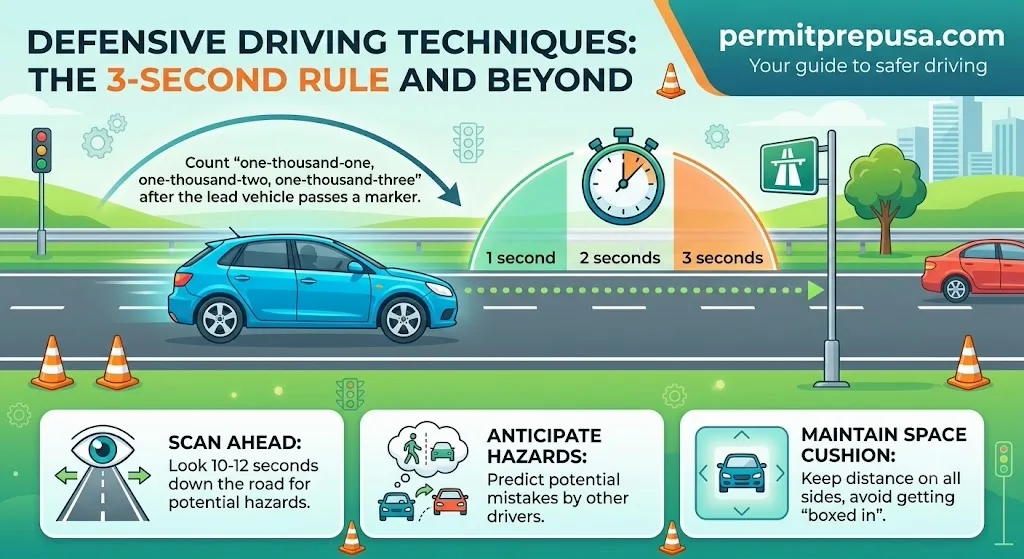
Quick-Answer Box: To pass the defensive driving portion of your DMV permit test, you must prove that you can proactively manage risk. Defensive driving is built on three core pillars: 1) Space Management: Maintaining a minimum 3-second following distance (increased to 4 or more in bad weather or behind motorcycles). 2) Visual Scanning: Looking 10 to 15 seconds ahead of your vehicle to anticipate hazards before they materialize. 3) The Space Cushion: Keeping open space on all four sides of your vehicle to ensure you always have an "escape route" if another driver makes a sudden, dangerous maneuver.
Every single day at the DMV, I evaluate applicants who possess excellent mechanical control of the vehicle. They know how to turn the steering wheel, they know how to apply the brakes smoothly, and they know how to activate their turn signals. Yet, many of these applicants still fail their physical road tests, and even more fail the situational questions on the computerized written exam. Why? Because operating the machinery of a car is only 10% of driving. The other 90% is purely cognitive.
Driving is not a passive activity where you simply react to things as they happen. If you wait until the car in front of you slams on its brakes to start thinking about your own stopping distance, you are already too late. As we established in our breakdown of what is the basic speed law, physics is unforgiving. A vehicle traveling at highway speeds covers roughly 100 feet per second. By the time your brain registers a threat and your foot hits the brake pedal, you have already traveled the length of a basketball court.
To survive the American highway system and pass the written exam with a flawless score, you must master the art of Defensive Driving. This means anticipating the mistakes of others, aggressively managing your spatial boundaries, and constantly scanning the road for hidden threats. Let’s execute a deep-dive breakdown into the exact defensive techniques the DMV tests you on, starting with the most famous spatial metric in traffic law: the 3-second rule.
Space Management: Mastering the 3-Second Rule
The most common cause of rear-end collisions is tailgating (following too closely). Novice drivers frequently judge their following distance by car lengths. The DMV categorically rejects the "car length" method because it is impossible to accurately estimate physical distance while moving at high speeds, and the required distance changes exponentially as your speed increases.
Instead, all state driving manuals use a time-based metric known as the 3-Second Rule. This rule guarantees that regardless of your speed, you will theoretically have enough perception and reaction time to stop if the vehicle in front of you suddenly halts.
How to Calculate the 3-Second Rule
You will likely face a question on the DMV kiosk asking you exactly how to measure this distance. Here is the examiner-approved method:
- Watch the rear bumper of the vehicle directly in front of you.
- Wait for that vehicle to pass a fixed, stationary object on the side of the road. This could be a speed limit sign, an overpass shadow, a tree, or a painted line (like the ones we detailed in understanding road pavement markings).
- As soon as the car passes the object, begin counting: "One-thousand-one, one-thousand-two, one-thousand-three."
- If the front bumper of your car passes that exact same stationary object before you finish saying "three," you are tailgating. You must immediately ease your foot off the accelerator and increase your following distance.
When to Increase to 4 or 5 Seconds
The 3-second rule only applies under perfectly ideal, dry, daylight conditions. The DMV exam will test your knowledge of when to expand this spatial buffer. You must increase your following distance to 4, 5, or even 6 seconds under the following circumstances:
- Slippery Roads: Rain, snow, or ice drastically increase your physical braking distance.
- Following Motorcycles: As we discussed in sharing the road with motorcycles, two-wheeled vehicles can stop much faster than passenger cars, often without their brake lights illuminating.
- Following Large Trucks: If you drive too closely behind a commercial semi-truck, you enter their rear "No-Zone" and completely lose your forward visibility. If you cannot see the truck's side mirrors, the driver cannot see you.
- Towing a Trailer: The added weight of a trailer significantly increases your vehicle's forward momentum, requiring much more time to come to a complete halt.
Visual Scanning: The 10-to-15 Second Visual Lead
A fatal flaw among inexperienced drivers is target fixation—staring exclusively at the license plate of the car directly in front of them. Defensive driving requires active, continuous visual scanning.
The DMV manual mandates that you maintain a 10 to 15-second visual lead. This means you should be looking down the road at the exact spot your vehicle will reach in 10 to 15 seconds. At city speeds (30 MPH), this equals about one full city block. At highway speeds (65 MPH), this equals about one-quarter of a mile.
By scanning far ahead, you allow your brain to process hazard indicators long before they become immediate threats. You will spot the flashing brake lights of a traffic jam, recognize a stale green light that is about to turn yellow, or notice a pedestrian stepping into an unmarked crosswalk. If you only look 3 seconds ahead, every single hazard will require a panic-braking maneuver.
Mirror Management and the SMOG Technique
Your side and rearview mirrors are your only defense against side-swipe collisions, but they possess massive structural flaws: blind spots. A blind spot is the area of the roadway that cannot be seen by looking forward or by glancing in your mirrors. They are typically located diagonally behind the driver and passenger sides of the vehicle.
The DMV written test and the practical road test aggressively evaluate your ability to manage blind spots before changing lanes. To execute a flawless, legally compliant lane change, you must memorize the SMOG technique:
- S - Signal: Activate your turn signal at least 100 feet before executing the maneuver to communicate your intent to other drivers.
- M - Mirrors: Check your rearview mirror to gauge the speed of traffic behind you, then check your side mirror on the side you intend to merge into.
- O - Over-the-Shoulder: This is the most critical step. You must physically turn your chin to your shoulder and look through the rear side window to verify that a motorcycle or small car is not hiding in your blind spot.
- G - Go: If the spatial cushion is clear, smoothly guide the steering wheel into the adjacent lane. Do not jerk the wheel or hit the brakes.
The Space Cushion: Creating an Escape Route
Defensive drivers do not allow themselves to get "boxed in." A space cushion is the physical area of empty asphalt you maintain on all four sides of your vehicle (front, rear, left, and right). Maintaining this cushion ensures that you always have an "escape route" or "out" if an emergency occurs.
For example, if you are driving in the middle lane of a three-lane highway, and you have a massive semi-truck directly to your left, a concrete barrier to your right, and a tailgater riding your rear bumper, you have zero escape routes. If the truck blows a tire and swerves into your lane, you have nowhere to go. A defensive driver will either accelerate slightly or decelerate to stagger their vehicle, ensuring the left or right lane remains open as a bailout zone.
Defensive Yielding at Intersections
Intersections are the most lethal geographic points on the American roadway. As we established in our master guide on who has the right of way, having the legal right-of-way does not physically protect your car from a collision. Defensive driving at intersections requires absolute paranoia.
When you approach an intersection on a fresh green light, you must never blindly accelerate. You must execute the Left-Right-Left scanning protocol. Look left (the closest lane of cross traffic), look right, and look left again. You are actively searching for drivers who are distracted, drivers attempting to run a red light, or pedestrians stepping off the curb.
If you are waiting to make an unprotected left turn in the center of the intersection, a defensive driver will keep their front wheels pointed straight. If you turn your wheels to the left while waiting for a gap in traffic, and a distracted driver rear-ends you, your turned wheels will launch your vehicle directly into oncoming high-speed traffic, resulting in a catastrophic head-on collision.
Defensive Driving Matrix (Examiner's Cheat Sheet)
To help you prepare for the situational questions on the written permit exam, I have organized the most common defensive driving scenarios into a streamlined reference table. Memorize these required defensive actions.
| Hazardous Road Scenario | Required Defensive Action (DMV Approved) |
|---|---|
| Aggressive Tailgater | Do not brake check. Gradually reduce speed to encourage passing, or safely merge into the right-hand lane. |
| Stale Green Light | A light that has been green for a long time. Cover the brake. Remove your foot from the gas and hover it over the brake pedal in anticipation of the yellow light. |
| Sun Glare or Fog | Increase following distance to 5+ seconds. Turn on low-beam headlights. Use the solid white right-edge line (fog line) as a steering guide. |
| Approaching a Blind Curve | Reduce speed before entering the curve. Do not brake sharply inside the curve, as this shifts the vehicle's weight and can cause a spinout. |
| Tire Blowout at High Speed | Grip the steering wheel firmly. Do NOT slam on the brakes. Take your foot off the gas, allow the vehicle to slow down naturally, and steer safely to the shoulder. |
Cognitive Load and Distracted Driving
The ultimate failure of defensive driving is distraction. The DMV evaluates your understanding of cognitive load. Texting and driving is not just dangerous because your eyes are off the road; it is lethal because your brain is cognitively detached from the task of operating heavy machinery.
Psychologists refer to this as Inattentional Blindness. When your brain is processing a text message or a complex phone conversation, you can look directly through the windshield at a red light or a pedestrian and completely fail to "see" them. Your eyes collect the data, but your brain fails to process the threat. This is why all 50 states have enacted strict bans on texting, and why the DMV will instantly fail you on the written test if you do not select the most rigorous anti-distraction answers available.
An Examiner's Final Blueprint for Survival
When you walk into our DMV branch to take your computerized written test, you must leave your ego at the door. The testing algorithm is designed to punish aggressive, impatient, and reactive mindsets.
Every time a question asks what you should do in a confusing or hazardous situation, the correct answer will almost always involve slowing down, increasing your space cushion, yielding the right-of-way, or checking your blind spots. Understand that defensive driving is a continuous, active process of threat assessment. If you master the SMOG technique, live by the 3-second rule, and maintain a 15-second visual lead, you will not only ace the DMV permit test, but you will also ensure that you survive the thousands of miles you are about to drive over the course of your lifetime.
