The Examiner’s Direct Answer: The Three Tiers of Speed Laws
Quick-Answer Box: To pass the DMV permit test, you must understand that speed limits are governed by three distinct legal frameworks. 1) The Basic Speed Law: You may never drive faster than is safe for current road, weather, or traffic conditions, regardless of the posted sign. 2) Absolute Speed Limits: The strict maximum speed posted on regulatory black-and-white signs. 3) Minimum Speed Limits: The statutory requirement that prohibits driving so slowly that you impede the normal, reasonable flow of traffic. Violating the Basic Speed Law during adverse conditions is the most common reason applicants fail situational questions on the written exam.
Every week, I grade computerized written exams that have been failed by applicants who fundamentally misunderstand how speed laws operate. When I review their failure logs, I see the exact same pattern. The terminal presented a question like: "The speed limit is 65 MPH, but it is raining heavily and traffic is heavily congested. How fast should you drive?" The applicant, relying on a rigid misinterpretation of the law, selects "65 MPH because that is what the sign says." That answer triggers an immediate score deduction.
As a veteran DMV examiner, let me clarify an absolute reality of the roadway: the number painted on a black-and-white regulatory sign is not a guaranteed entitlement. It is a maximum threshold that only applies under perfectly ideal, pristine driving conditions. The state legislature does not print speed limit signs to override the laws of physics, nor do those signs absolve you of your responsibility to operate the vehicle defensively.
Speed management is the most critical survival skill you must demonstrate, both on the computerized kiosk and during your eventual behind-the-wheel road test. Speeding reduces your visual field, exponentially increases your braking distance, and amplifies the kinetic energy transferred during a collision. To guarantee your success on the written evaluation and keep your driving record clean, we are going to execute an exhaustive, deep-dive architectural breakdown of the Basic Speed Law, decode the physics of stopping distances, and establish a bulletproof framework for navigating speed-related questions on the exam.
The Fundamental Concept: The Basic Speed Law
The foundation of all traffic regulation in the United States is the Basic Speed Law. While its exact phrasing varies slightly from state to state (sometimes referred to as the "Reasonable and Prudent" rule), the legal mandate remains universally identical across the country.
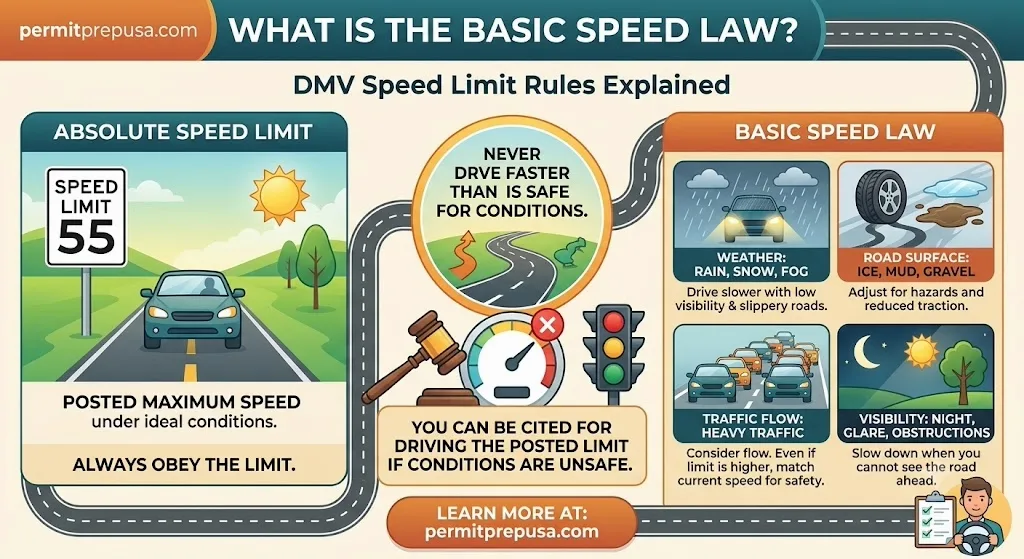
The Basic Speed Law dictates that you must never drive a vehicle at a speed greater than is reasonable and prudent under the conditions and having regard to the actual and potential hazards then existing. This means your speed must be continuously dynamically adjusted based on four critical environmental variables:
- The Volume and Speed of Traffic: If you are driving on an interstate with a posted limit of 70 MPH, but a severe traffic jam has reduced the flow of vehicles to 30 MPH, your legal limit is now 30 MPH. Attempting to weave through congested traffic at 70 MPH is a reckless driving violation.
- The Condition of the Road Surface: The posted limit assumes dry, smooth asphalt. If the road is slick with fresh rain, covered in black ice, or degraded by severe potholes and construction grating, the Basic Speed Law legally compels you to reduce your speed significantly below the posted threshold.
- Visibility and Illumination: If dense fog, heavy snowfall, or torrential rain reduces your forward visibility to less than 500 feet, driving at the posted highway speed is suicidal. You must lower your speed to ensure your stopping distance does not exceed your visual range.
- Pedestrian and Bicycle Density: When entering urban environments, shopping districts, or residential neighborhoods, the presence of vulnerable road users requires an immediate, drastic reduction in speed, aligning with the yielding matrices we deconstructed in dmv right of way rules intersections.
If you are pulled over by a law enforcement officer for driving 45 MPH in a 45 MPH zone during a severe blizzard, the officer will cite you for violating the Basic Speed Law. Arguing that you were "doing the speed limit" will not hold up in traffic court, nor will it save your score buffer on the computerized DMV kiosk.
Absolute Limits vs. Prima Facie Limits
Once you understand the overarching umbrella of the Basic Speed Law, you must understand the two distinct ways state governments post numerical speed limits: Absolute Limits and Prima Facie (Presumed) Limits.
Absolute Speed Limits
In states with absolute speed limit laws, the number on the sign is an uncompromising legal ceiling. If the sign says 55 MPH and you are clocked by a radar gun at 56 MPH, you have mathematically violated the law. There is no legal gray area or "buffer zone" in the statutory code. While some police officers may grant a small grace margin out of professional discretion, the DMV testing terminal does not. On the exam, exceeding an absolute limit by even one mile per hour is considered illegal.
Prima Facie (Presumed) Speed Limits
States like California and Texas operate on a "Prima Facie" framework for certain zones. Prima Facie is a Latin legal term meaning "on its face" or "at first glance." In these jurisdictions, a posted speed limit (like 25 MPH in a residential area) is the presumed safe speed. However, it is legally flexible in court. If you are cited for driving 30 MPH in a 25 MPH Prima Facie zone, you can theoretically argue before a judge that your speed was perfectly safe given the empty, dry conditions of the road at that specific moment.
However, Examiner's Warning: Do not attempt to apply Prima Facie flexibility on the written permit test. The software algorithm operates in absolute binaries. If the question asks for the maximum legal speed in a school zone, you must select the exact numerical statutory limit, not a "flexible" estimate.
The Physics of Stopping Distance: The Three Variables
The Department of Motor Vehicles heavily tests your understanding of stopping distances. Many applicants falsely believe that a car moving at 60 MPH can stop in the exact same distance as a car moving at 30 MPH. This demonstrates a dangerous ignorance of vehicular physics.
When you double your speed, your braking distance does not simply double—it quadruples. To stop a moving vehicle, you must sequentially execute three distinct phases, known collectively as Total Stopping Distance.
1. Perception Time
This is the amount of time it takes your brain to recognize a hazard on the road (such as a child running into the street or the brake lights of the car ahead illuminating). For a healthy, sober, fully alert driver, perception time averages about 0.75 to 1 full second. If you are distracted by a mobile device—which we completely banned in our breakdown of learner's permit restrictions every teen should know—your perception time skyrockets, rendering you unable to react before the collision occurs.
2. Reaction Time
Once your brain perceives the hazard, it must send a neurological signal to your leg to lift your foot off the accelerator and physically depress the brake pedal. This physical movement takes approximately 0.75 seconds. At highway speeds (65 MPH), your vehicle travels nearly 100 feet per second. This means that before your foot even touches the brake pedal, your car has already traveled 150 to 200 feet towards the hazard.
3. Braking Distance
This is the physical distance the vehicle travels after the brakes are applied until it reaches a complete, dead stop. Braking distance is entirely dependent on the mechanical condition of your tires, the weight of your vehicle, and the friction coefficient of the asphalt (which drops dramatically when wet or icy).
When you combine Perception, Reaction, and Braking distances, the reality is stark. A standard passenger vehicle traveling at 55 MPH requires nearly 400 feet (more than the length of an American football field) to come to a complete stop. This is why following the Basic Speed Law is critical.
Standard Speed Limit Benchmarks by Zone (Mobile-Friendly Matrix)
On the written permit test, you will frequently face questions that present a specific environment without showing you a speed limit sign. You are expected to know the statutory "unposted" speed limits for various geographical zones.
While local municipalities can alter these numbers with regulatory black-and-white signs—the exact parameters of which we mapped out in how to read traffic signs and signals—the state enforces baseline defaults. I have structured a reference table tracking the universal statutory speed limits across the United States. Ensure you commit these benchmarks to memory.
| Geographical Zone or District | Standard Speed Limit & Examiner Notes |
|---|---|
| School Zones | 15 to 25 MPH Strictly enforced when children are present, during school hours, or when warning lights are flashing. Fines are typically doubled. |
| Residential & Business Districts | 25 to 30 MPH Areas with high pedestrian density, hidden driveways, and parallel parked cars that obstruct lateral visibility. |
| Rural Two-Lane Highways | 55 MPH The standard limit for undivided state routes. Passing is only permitted across dashed lines as explained in understanding road pavement markings and lines. |
| Multi-Lane Freeways (Urban) | 65 MPH Congested interstate systems passing through city centers. Speed limits are lowered to account for heavy merging traffic. |
| Interstate Highways (Rural) | 70 to 80+ MPH Wide, divided highways in open country (e.g., Texas or Montana). Maximum legal speed for passenger vehicles under ideal conditions. |
Weather Conditions and Speed Reduction Formulas
The DMV algorithm will ruthlessly test your knowledge of speed reduction ratios during adverse weather conditions. You must memorize these exact administrative formulas, as they are non-negotiable for passing the kiosk evaluation.
Wet Roads and Hydroplaning
When it begins to rain, the water mixes with the oil and dust that has settled on the asphalt, creating an incredibly slick surface during the first 30 minutes of a downpour. The standard DMV rule requires you to reduce your speed by 5 to 10 MPH on wet roads.
If you drive faster than 35 MPH in heavy rain, you risk hydroplaning. This occurs when your tires lose physical contact with the asphalt and begin to ride on a thin layer of standing water. If you hydroplane, your steering wheel and brakes become completely useless. You must ease your foot off the gas pedal entirely and allow the vehicle to slow down naturally until traction is restored.
Packed Snow
Driving on snow drastically reduces your tire's coefficient of friction. The DMV manual legally mandates that you must cut your speed in half when driving on packed snow. If the posted limit is 50 MPH, your maximum safe speed is 25 MPH.
Ice and Black Ice
Ice is the ultimate hazard. When navigating icy roads, the state requires you to reduce your speed to a slow crawl. You must be particularly vigilant for "black ice," which is a transparent layer of ice that looks like wet asphalt. Black ice forms rapidly in shaded areas, under overpasses, and on bridges, because cold air circulates underneath the elevated structure, freezing the surface much faster than solid ground roads.
The Danger of Driving Too Slowly (Minimum Limits)
While speeding is heavily penalized, driving too slowly can be just as hazardous. If you merge onto a 70 MPH interstate highway and insist on driving 35 MPH in perfectly clear weather, you create a massive disruption in the traffic flow. Approaching vehicles will have to slam on their brakes or swerve dangerously to avoid rear-ending you.
To combat this, the state enforces Minimum Speed Laws. You will often see these posted on highways as a secondary black-and-white sign (e.g., "Speed Limit 70, Minimum 45"). If you fail to maintain the minimum speed, law enforcement can issue you a citation for impeding the flow of traffic.
Furthermore, if you are driving below the speed limit on a two-lane road and you notice a massive line of five or more cars trapped behind you, statutory law in many states (like California) dictates that you must use a designated turnout lane to pull over and let the faster traffic pass safely.
Administrative Penalties for Speeding on a Permit
We must discuss the administrative fallout of violating speed laws while operating on a temporary training credential. If you are pulled over for speeding while holding a learner's permit, the penalties are catastrophic compared to a fully licensed adult driver.
Because you are operating under the strict parameters of the Graduated Driver Licensing (GDL) system, a speeding ticket is not a simple fine. It will result in an immediate reset of your mandatory holding period. All of the practice months you accrued will be wiped out, and you will have to wait an additional six to twelve months without any violations before you are legally allowed to schedule your behind-the-wheel road test.
If the speeding violation is severe enough (e.g., driving 20 MPH over the limit in a school zone), the state may suspend your permit entirely. If your permit expires during this suspension window, you will face the grueling renewal penalties we broke down in what happens if you fail the DMV permit test, which includes paying full application fees and passing the written exam all over again.
An Examiner's Final Blueprint for Speed Control
Mastering speed control is the hallmark of a mature, defensive driver. When you sit down at the DMV kiosk to take your permit test, approach every speed-related question through the lens of the Basic Speed Law.
Do not be fooled by trick questions that offer the posted speed limit as the correct answer during a snowstorm. Remember that the law requires you to continuously adjust your velocity to match the current environmental hazards. Memorize the 400-foot braking distance matrix, respect the strict boundaries of school zones, and understand the lethal physics of hydroplaning.
If you internalize these legal thresholds and prioritize defensive caution over aggressive momentum, you will protect your score margin, clear the computerized evaluation easily, and prove to the state that you are finally ready to begin your physical behind-the-wheel training.
