The Examiner’s Direct Answer: The Ecosystem of the Highway
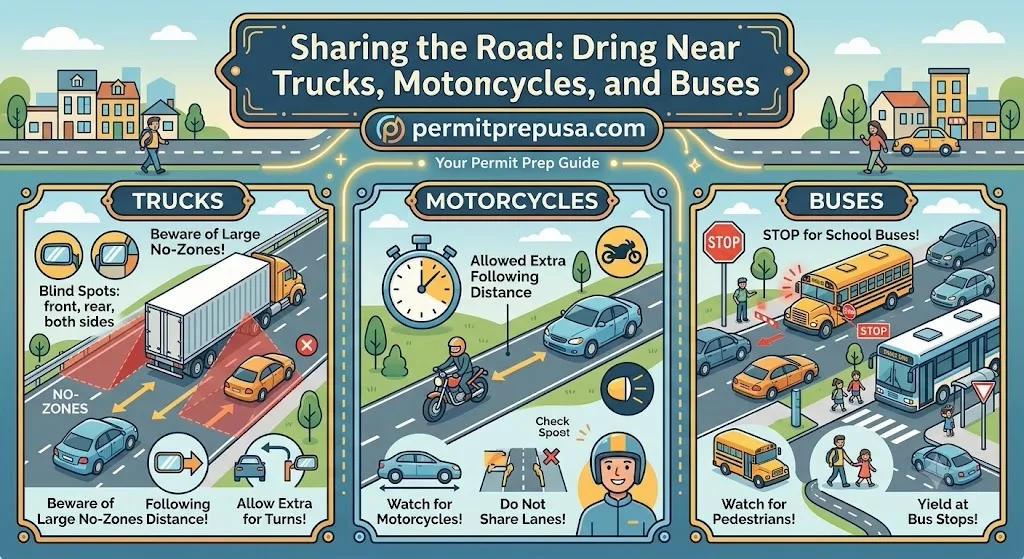
Quick-Answer Box: To pass the "Sharing the Road" section of your DMV permit test, you must understand the operational limitations of other vehicles. Commercial Trucks have massive blind spots called "No-Zones" on all four sides and require up to 400 feet to stop. You must never linger next to a truck or cut it off. Motorcycles require a greater following distance (at least 4 seconds) because they can stop much faster than cars and are easily hidden in your blind spots. When a School Bus flashes its red lights and extends its stop arm, traffic in both directions must come to a complete halt unless separated by a physical divided highway barrier.
One of the most dangerous illusions a novice driver can have is thinking they own the road. When you slide behind the wheel of a standard passenger sedan, it is easy to view the asphalt entirely through your own perspective. But the highway is a complex, high-speed ecosystem populated by vehicles of vastly different sizes, weights, and vulnerabilities. Every week at the DMV, I see permit test applicants fail their written exams because they fundamentally misunderstand how to interact with commercial vehicles, motorcycles, and school buses.
When an applicant misses a question about a commercial truck's blind spot or a school bus's flashing red lights, the testing software heavily penalizes their score. The state does not view these as minor trivia questions; it views them as life-and-death safety parameters. If you cut off an 80,000-pound semi-truck on the interstate because you did not understand its braking distance, the result is not a fender bender—it is a catastrophic fatality.
As a veteran DMV examiner, I am going to walk you through the precise legal and physical dynamics of sharing the road. We will map out the deadly "No-Zones" of commercial trucks, deconstruct the strict right-of-way laws protecting motorcycles and bicycles, and establish a foolproof framework for passing every single shared-road scenario on your computerized permit test.
Commercial Vehicles: Surviving the "No-Zones"
A fully loaded commercial tractor-trailer can weigh up to 80,000 pounds, which is roughly 20 times heavier than a standard passenger car. Because of this massive disparity in size and weight, commercial drivers face immense operational limitations. They cannot stop quickly, they cannot maneuver sharply, and they cannot see small vehicles driving directly next to them.
To survive driving near big rigs, you must memorize the concept of the "No-Zone." The No-Zone refers to the four massive blind spots surrounding a commercial truck where your passenger vehicle completely disappears from the truck driver's mirrors.
The Right-Side No-Zone (The Deadliest Blind Spot)
The largest and most dangerous blind spot on a commercial truck is on its right side. Because the driver sits high up on the left side of the cab, their view of the right lanes is severely restricted. The right-side No-Zone extends across two full lanes and angles deeply toward the rear. If you are cruising in this zone, the truck driver has absolutely no idea you are there. If they need to execute an emergency lane change to avoid a hazard, they will crush your vehicle. Examiner's Rule: Never linger on the right side of a truck. Either pass them swiftly and safely on the left, or back off and stay behind them.
The Left-Side No-Zone
While smaller than the right side, the left-side blind spot is still significantly larger than a passenger car's blind spot. It spans from the driver's window back toward the middle of the trailer. When you are executing a passing maneuver on the left, you must do so decisively. Do not pace the truck. Pass them, check your rearview mirror until you can see the entire front cab of the truck, and then merge back into the lane.
The Rear No-Zone (Tailgating a Truck)
Unlike passenger cars, commercial trucks do not have a rearview mirror inside the cab because the trailer blocks the entire rear view. The truck driver relies entirely on their side mirrors. If you are tailgating a truck, you are driving in a total visual vacuum. A good rule of thumb for the DMV test: If you cannot see the truck driver's face in their side mirrors, they cannot see you. Furthermore, if the truck blows a tire or forcefully applies its air brakes, you will have zero reaction time before sliding underneath the trailer.
The Front No-Zone and Cut-Off Collisions
Because an 80,000-pound truck carries immense forward kinetic energy, its stopping distance is massive. As we discussed in our guide on what is the basic speed law, a heavy truck traveling at 65 MPH can take over 400 feet (more than a football field) to come to a complete stop. If you pass a truck, immediately pull in front of it, and hit your brakes to make a highway exit, the truck driver will not be able to stop in time. You will be rear-ended and crushed. Always leave at least one full vehicle length of space for every 10 MPH of speed before merging in front of a big rig.
The Wide Right Turn Trap
One of the most frequent scenarios tested on the DMV kiosk involves a commercial truck making a right-hand turn at an intersection. Because trucks are extremely long, they must execute what is known as a "jug-handle" turn. To make a sharp right turn, the truck driver must first swing the cab wide into the left lane to clear the curb with the rear trailer tires.
Many novice drivers see the truck swing left, assume the truck is changing lanes or turning left, and attempt to squeeze past the truck on the right side. This is a fatal mistake. As the truck completes its right turn, the trailer will aggressively cut back toward the curb, completely crushing any vehicle that attempted to sneak into that gap. On the written test, if a truck is signaling a right turn but swings left, you must hold your position and wait for them to clear the intersection entirely.
Motorcycles and Mopeds: Vulnerability on Two Wheels
While commercial trucks are dangerous because of their massive size, motorcycles are dangerous because of their lack of size. Motorcycles have the exact same legal privileges on the roadway as a standard passenger vehicle, but they are incredibly difficult to see and offer their riders zero structural protection.
The DMV algorithm tests your knowledge of motorcycle safety rigorously. You must understand the following physical and legal dynamics:
Visual Recognition and Blind Spots
Because motorcycles are narrow, they are easily obscured by the pillars of your car's chassis (the A, B, and C pillars) or by other vehicles. A motorcycle can easily hide entirely within your vehicle's blind spot. Before changing lanes, you must physically turn your head and look over your shoulder to verify the space is clear. Relying solely on your side mirrors will eventually lead to a side-swipe collision with a motorcycle.
Following Distance and Braking Dynamics
Motorcycles are much lighter than passenger cars and can decelerate incredibly fast—often by simply downshifting their gears without ever touching the brakes. This means a motorcycle can slow down rapidly without its rear red brake lights ever illuminating. Because of this, the state legally mandates that you increase your following distance when driving behind a motorcycle. While a standard 3-second rule applies to cars, you must maintain a minimum 4-second following distance behind a motorcycle to allow adequate reaction time if they drop their speed suddenly or fall on slick pavement.
Lane Position and Lane Splitting
A motorcyclist is legally entitled to the full width of their travel lane. They will frequently shift positions from the left side of the lane to the right side to avoid potholes, oil slicks, or road debris. You must never attempt to share a single lane side-by-side with a motorcycle.
Additionally, you must understand the laws regarding "Lane Splitting" (a motorcyclist driving between two rows of stopped or slow-moving traffic). Lane splitting is legally authorized in states like California, provided it is done safely, but it is strictly illegal in the vast majority of other U.S. states. You must review your local state driver's manual to know if you are required to yield space to lane-splitting riders.
Turn Signal Traps
Unlike modern passenger vehicles, many motorcycle turn signals do not automatically cancel after the rider completes a turn. It is incredibly common for a motorcyclist to ride for miles with a flashing blinker they forgot to turn off. If you are waiting at a stop sign (applying the rules from our breakdown on who has the right of way) and you see an approaching motorcycle with its right turn signal flashing, do not pull out in front of them. Wait until the motorcycle actually begins to execute the physical turn before you enter the intersection.
School Buses: The Absolute Zero-Tolerance Law
There is no traffic law more aggressively enforced by the police and the courts than the school bus stop law. If you fail to stop for a school bus, you will not just fail your DMV test; you will face massive fines, an immediate suspension of your driver's license, and potential criminal charges.
The statutory rule is highly specific and relies on the structure of the roadway:
Undivided Highways and Local Streets
If you are driving on a two-lane residential street, a multi-lane city street with a center turning lane (as detailed in understanding road pavement markings), or any road without a physical barrier, the rule is absolute. When a school bus stops, flashes its red lights, and extends its mechanical stop arm, traffic moving in both directions must come to a complete and total stop. You must remain stopped until the red lights stop flashing, the stop arm is retracted, and all children have safely cleared the roadway.
Divided Highways (The Only Exception)
The only legal exception to the school bus stop law occurs on a divided highway. A divided highway is a road split by a physical, unpaved median (such as a grassy strip, a concrete jersey barrier, or a raised concrete island). If the school bus is stopped on the opposite side of a physical divided highway, you are not legally required to stop. However, you must drastically reduce your speed and proceed with extreme caution, as unpredictable children may still be in the vicinity.
Bicyclists and the 3-Foot Clearance Rule
Bicycles are legally classified as vehicles under the state transportation code. Cyclists have the exact same right to utilize public roadways as automobiles, and they must obey the exact same traffic signs and signals (which we decoded in how to read traffic signs and signals).
When sharing the road with a bicyclist, you are legally mandated to provide a safe spatial buffer. In almost all states, this is codified as the 3-Foot Clearance Rule. When you pass a bicyclist traveling in the same direction, you must leave a minimum of three feet of physical space between the widest part of your vehicle (usually your side mirror) and the cyclist. If the lane is too narrow to provide three feet of clearance, you must slow down and wait patiently behind the cyclist until it is safe to change lanes and pass.
The "Right Hook" Collision Trap
The most common and deadly collision between a car and a bicycle is the "Right Hook." This occurs when a driver passes a bicyclist on the left, immediately merges into the right lane, and hits their brakes to make a right-hand turn at an intersection. The driver cuts off the bicyclist's path of travel, causing the cyclist to crash violently into the passenger side of the car.
To avoid a right hook, you must check your blind spot, ensure the cyclist is fully behind your vehicle, and merge into the designated bike lane (only when authorized by a broken white line) before initiating your turn. Never race a cyclist to an intersection.
Emergency Vehicles and the Move Over Law
The final pillar of sharing the road involves interacting with emergency and utility vehicles. We briefly touched on emergency right-of-way, but the state heavily tests your operational response to stationary emergency vehicles under the Move Over Law.
If you are driving on a multi-lane highway and approach a police cruiser, fire engine, ambulance, tow truck, or state utility vehicle stopped on the right shoulder with its amber or red lights flashing, the law demands an immediate reaction. You must safely change lanes away from the shoulder, vacating the lane closest to the emergency workers to provide them with a protective physical buffer.
If traffic volume or a solid white line prevents you from safely changing lanes, the Move Over Law dictates that you must drastically reduce your speed (typically 20 MPH below the posted limit) and proceed past the scene with extreme caution. Failing to move over or slow down is a primary offense that carries severe point penalties against your driving abstract.
An Examiner's Final Warning on Mutual Respect
Passing the "Sharing the Road" section of your DMV permit test requires you to adopt a mindset of profound defensive driving and mutual respect. The state does not expect you to memorize how to drive a commercial semi-truck; it expects you to respect the physical limitations of the driver operating it.
When you sit down at the testing terminal, look for the answer choices that prioritize caution, spatial awareness, and yielding. Never assume a truck can stop for you, never assume a motorcycle is not hiding in your blind spot, and never ignore the flashing red lights of a school bus.
By mastering the rules of the No-Zone, respecting the vulnerability of two-wheeled riders, and adhering strictly to the Move Over Laws, you will easily protect your score buffer on the written exam. More importantly, when you finally graduate past the restrictions discussed in learner's permit restrictions every teen should know and begin driving independently, this knowledge will ensure you survive the chaotic, mixed-vehicle reality of the American highway system.
