The Examiner’s Direct Answer: The Asphalt Language
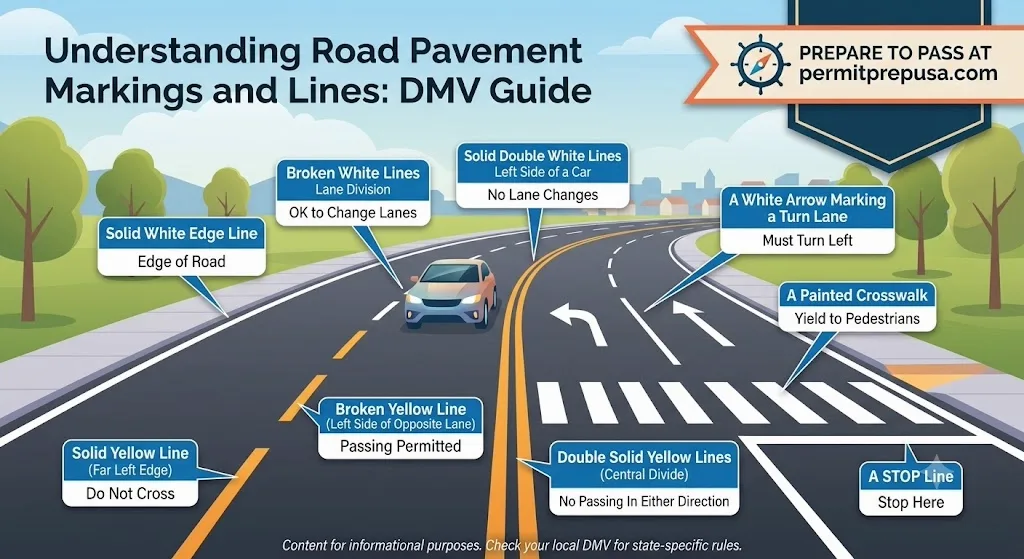
Quick-Answer Box: To pass the DMV permit test, you must understand the two foundational rules of pavement markings: Color and Continuity. Yellow lines always separate traffic moving in opposite directions, while White lines separate traffic moving in the same direction. Regarding continuity, a broken (dashed) line grants you the legal right to cross or pass when it is safe to do so. Conversely, a solid line strictly prohibits or strongly discourages crossing, passing, or changing lanes. Mastering this painted matrix is non-negotiable for passing your written evaluation.
Every morning, before I unlock the doors to our DMV branch, I watch novice drivers pull into our parking lot for their road tests. Within thirty seconds, I can usually predict who is going to fail. Why? Because I watch them completely ignore the thick painted lines on the asphalt. They drift across solid white channelizing lines, stop their vehicle directly on top of the crosswalk limit lines, and ignore directional arrows painted in the turning lanes.
When these applicants ultimately fail their written knowledge exam at our computerized kiosks, they frequently complain that the questions were overly tricky. They will tell me, "Examiner, I studied all the metal signs on the poles, but the test asked me a dozen questions about lines painted on the road!"
As a veteran DMV examiner, let me lay down an absolute operational truth: the lines painted on the asphalt carry the exact same statutory and legal weight as any aluminum sign bolted to a steel pole. The road itself is a continuous, scrolling instruction manual. When you are driving at high speeds, especially at night or in dense fog, overhead signs may become completely invisible. In those critical, low-visibility scenarios, your life depends entirely on your ability to read the reflective pavement markings directly beneath your tires.
Failing to master this structural data will not only decimate your score margin on the computerized written exam, but it will also lead to immediate moving violations once you hold a permit. To ensure you understand the legal boundaries of the roadway, we are going to execute a massive, deep-dive architectural breakdown of every single pavement marking, dissect the strict rules of curb colors, and establish a foolproof framework to help you pass these questions instantly.
The Chromatic Foundation: White vs. Yellow Lines
Before we discuss passing zones or intersection rules, you must understand the primary chromatic code of the American highway system. The Federal Highway Administration utilizes two core colors for longitudinal lines (the lines that run parallel to your vehicle). Memorizing the difference between these two colors is the ultimate foundation of lane discipline.
The Yellow Line Matrix: Opposite Directions
Yellow lines are the most critical safety barrier on the road. A yellow line mathematically dictates that the traffic on the other side of that line is traveling directly toward you. If you cross a yellow line incorrectly, you are driving head-on into oncoming traffic.
Beyond separating opposing lanes of traffic, the solid yellow line serves a secondary, highly specific purpose on divided highways and one-way streets. On a divided highway featuring a physical center median or concrete barrier, a solid yellow line is always painted on the far-left edge of the road, directly adjacent to the median. It serves as your left-hand boundary marker. If a solid yellow line is on your right side, you are driving the wrong way down a highway.
The White Line Matrix: Same Directions
White lines indicate that the traffic on the adjacent side of the line is flowing in the exact same direction as your vehicle. When you are traveling on a multi-lane interstate highway featuring three, four, or five lanes, these lanes are divided by white markings.
Additionally, a solid white line is universally used to mark the right edge of the roadway. This line, known as the "fog line," is highly reflective. It is designed to keep you from drifting off the paved asphalt onto the dirt shoulder, especially during heavy rain or dense nighttime conditions.
The Geometry of the Lines: Solid vs. Broken
Once you understand what the color of the line dictates about the flow of traffic, you must look at the geometry of the paint. The continuity of the line—whether it is solid or broken into segments—tells you exactly what maneuvers are legally authorized.
Single Broken Yellow Line
This marking is typically found on rural, two-lane roads. It indicates that you are driving on a two-way road (due to the yellow color) and that passing is legally authorized. If you are stuck behind a slow-moving tractor, you may cross the broken yellow line into the oncoming traffic lane to execute a passing maneuver, provided you have clear visibility and no oncoming vehicles are approaching.
Double Solid Yellow Lines
This is an absolute, impenetrable legal barrier. Double solid yellow lines indicate a strict "No Passing Zone" for both directions of traffic. You are never allowed to cross double solid yellow lines to pass another vehicle, period. The only legal exception to crossing a double solid yellow line in most states is if you are making a deliberate, perpendicular left turn into a private driveway, business entrance, or cross street.
Solid Yellow Line Paired with a Broken Yellow Line
You will frequently encounter this hybrid marking on winding mountain roads or hills. In this configuration, the legality of passing depends entirely on which line is closest to your vehicle. If the broken dashed line is on your side, you hold the legal right to pass. If the solid yellow line is on your side, you are strictly prohibited from passing, even if the road ahead looks completely clear. This system is designed to grant passing privileges only to the side of the road with superior forward visibility.
Single Broken White Line
This is the standard lane divider on freeways, interstates, and multi-lane city streets. It separates traffic moving in the same direction and indicates that you are fully authorized to change lanes or pass other vehicles, provided you signal your intentions and verify your blind spots.
Single Solid White Line
A single solid white line separates traffic moving in the same direction, but it serves as a strict administrative warning. It dictates that changing lanes is heavily discouraged and potentially hazardous. You will typically see solid white lines painted as you approach an intersection, a toll plaza, or a highway exit ramp. The state wants you to maintain your current lane and stop weaving before you reach the conflict point.
Double Solid White Lines
While somewhat rare on local streets, double solid white lines are used on major interstates to separate standard travel lanes from preferential lanes, such as High Occupancy Vehicle (HOV) carpool lanes or express toll lanes. Crossing double solid white lines to enter or exit a lane is strictly prohibited and carries a massive moving violation fine. You must wait until the double lines transition back into a broken dashed line before executing your lane change.
The Center Left Turn Lane (The "Suicide Lane")
One of the most complex pavement markings—and a massive trap on the computerized written test—is the Center Two-Way Left Turn Lane. It is located in the absolute center of a busy, multi-lane city street.
This lane is enclosed by a very specific boundary pattern on both sides: a solid yellow line on the outside, and a broken yellow line on the inside.
The rules governing this lane are strict and frequently misunderstood by novice permit holders:
- Exclusive Purpose: This lane is strictly reserved for vehicles preparing to make a left-hand turn off the main roadway into a driveway or cross street.
- No Passing: It is highly illegal to use this center lane as an express passing lane to bypass slow traffic.
- Distance Limits: Because vehicles from both directions of traffic are authorized to enter this shared lane simultaneously (hence the nickname "suicide lane"), you are strictly limited in how far you can travel within it. In most states, you are legally prohibited from driving inside the center left turn lane for more than 200 feet before executing your turn.
Intersection Markings: Limit Lines and Crosswalks
When you approach a stop sign or a red traffic signal, the pavement markings dictate the exact geographical centimeter where your vehicle must halt. Failing to respect these intersection boundaries is the fastest way to trigger the automatic failures we discussed in our guide detailing what happens if you fail the DMV permit test.
The Limit Line (Stop Line)
This is a thick, solid white line painted horizontally across your travel lane just before an intersection. By statutory law, the absolute front bumper of your vehicle must come to a complete cessation of momentum behind this line. If your front tires cross the limit line while the light is red, you have legally run the intersection, even if your vehicle physically stopped moving.
Crosswalk Boundaries
Crosswalks are typically marked by two parallel horizontal white lines or a series of thick vertical white blocks (often called a ladder or continental crosswalk). Pedestrians always hold the ultimate right-of-way inside these boundaries. If an intersection features a crosswalk but no painted limit line, you must bring your vehicle to a complete stop directly before entering the crosswalk zone.
Shark's Teeth (Yield Lines)
At roundabouts and dedicated yield points, you will often see a row of solid white triangles painted across the lane, pointing directly at your vehicle. These are known as yield lines or "shark's teeth." They indicate the exact point where you must yield the right-of-way to cross-traffic. You are not required to stop at these triangles unless opposing traffic creates an immediate collision hazard.
Special Purpose Lanes and Pavement Symbols
The DMV written test loves to evaluate your knowledge of specific geometric symbols painted directly onto the asphalt. These symbols convey complex regulatory laws without requiring overhead signage.
The White Diamond (HOV Lanes)
If you see a large, elongated white diamond painted in the center of a travel lane, you are looking at a High Occupancy Vehicle (HOV) lane, commonly known as a carpool lane. You are legally prohibited from driving in a diamond-marked lane unless your vehicle meets the minimum passenger requirement posted on the adjacent regulatory signs (usually two or three occupants).
The Sharrow (Shared Lane Marking)
A sharrow consists of a bicycle symbol positioned directly underneath two chevron arrows pointing forward. This is not a dedicated bicycle lane. Instead, it informs automobile drivers that the current travel lane is too narrow to safely accommodate a car and a bicycle side-by-side. It legally instructs the automobile driver that cyclists are allowed to occupy the full center of the travel lane, and the driver must share the road patiently.
Mandatory Turn Arrows
If you enter a lane and see a large white arrow painted on the asphalt pointing strictly to the right, accompanied by the word "ONLY", you are in a mandatory turn lane. Once you cross the solid white boundary into this lane, you are legally committed. You cannot change your mind at the intersection and attempt to go straight; you must execute the turn as dictated by the pavement geometry.
Parking Lot and Curb Color Codes (Crucial Exam Data)
One of the most heavily tested sections on the DMV permit kiosk involves curb colors. The state uses colored paint on sidewalk curbs to regulate parking laws in high-density urban areas. You must memorize this chromatic data, as it is a fundamental pillar of the curriculum we mapped out in how to read traffic signs and signals.
I have structured a mobile-friendly reference table tracking the universal definitions of painted curbs across the United States. Ensure you commit these to memory before sitting at my terminal.
| Curb Paint Color | Strict Legal Parking Definition and Duration |
|---|---|
| Red Curb | Absolute Prohibition: No stopping, standing, or parking under any circumstances. Typically marks fire hydrants, bus stops, or emergency access routes. |
| White Curb | Passenger Drop-Off Only: Brief stops allowed strictly for loading or unloading passengers or depositing mail. You must remain with your vehicle. |
| Yellow Curb | Commercial Loading Zone: Reserved for loading and unloading heavy freight or passengers. Drivers of non-commercial passenger vehicles must usually stay with their car. |
| Green Curb | Time-Limited Parking: Parking is allowed, but strictly limited to a specific time duration (e.g., 15 or 30 minutes). Look for painted numbers on the curb or nearby signs. |
| Blue Curb | Disabled Parking Only: Strictly reserved for vehicles displaying a state-issued disabled placard or specialized license plate. Massive fines apply for violations. |
How Pavement Markings Dictate Your Test Score
Understanding these lines is not just about passing the test; it is about surviving the physical road. When you finally move beyond the written evaluation and begin accumulating your behind-the-wheel hours under the restrictive mandates we discussed in learner's permit restrictions every teen should know, your supervising adult will expect you to read the asphalt effortlessly.
If you fail to understand the difference between a broken white line and a solid yellow line on the computerized exam, the software will immediately flag your profile for critical knowledge gaps. Our terminal algorithms aggressively target these concepts. If you want to review the exact mathematical scoring threshold you must defend against these questions, revisit our master metric guide on what score do you need to pass the DMV permit test.
The state legislature paints these lines for a reason. They create predictable order out of high-speed chaos. You must study the specific pavement section of your state's driver manual until you can close your eyes and perfectly visualize the rules governing a center left-turn lane or a double solid white carpool barrier.
An Examiner's Final Warning on Lane Discipline
Do not dismiss pavement markings as secondary information. Many novice drivers focus entirely on the speed limit signs and completely ignore the architectural boundaries painted directly under their vehicle.
As a DMV examiner, I can assure you that your ability to interpret asphalt markings is the ultimate test of your situational awareness. When you sit at our terminal and the screen presents a diagram of a complex, multi-lane intersection, do not panic. Look at the colors first, evaluate the continuity of the lines second, and let the geometry guide you to the correct answer. Master the asphalt language, protect your score buffer, and you will easily walk out of our branch with a valid learner's permit in your hand.
