The Examiner’s Direct Answer: The One Mistake You Cannot Fix
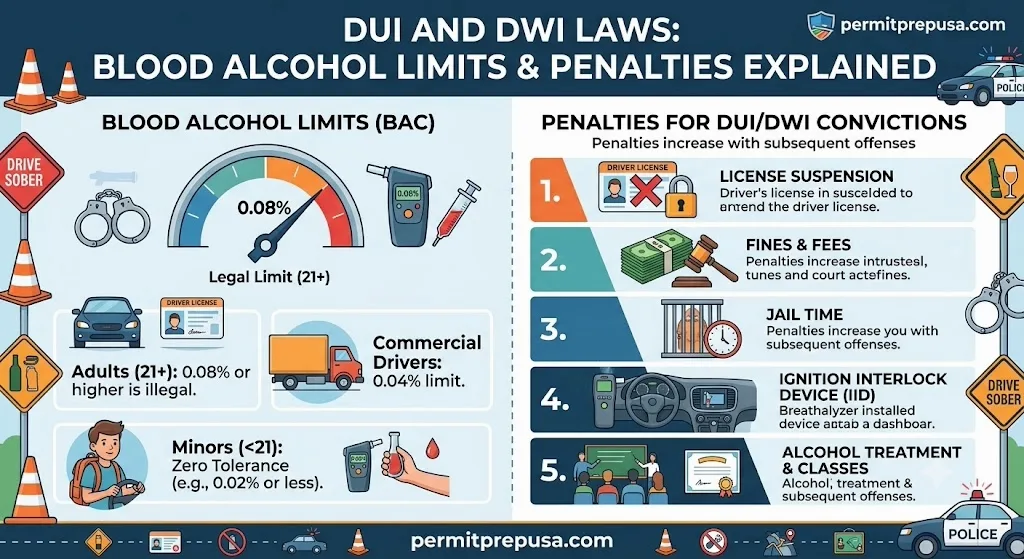
Quick-Answer Box: To pass the DMV permit test and survive the real roads, you must memorize the strict legal thresholds for alcohol impairment. In all 50 states (except Utah at 0.05%), the legal Blood Alcohol Concentration (BAC) limit for adult drivers is 0.08%. However, for commercial drivers, the limit drops to 0.04%. Most importantly, if you are under 21 years old, you are subject to strict Zero Tolerance Laws, meaning a BAC of just 0.01% or 0.02% will result in an immediate license suspension. Furthermore, by accepting a driver's license, you automatically agree to the Implied Consent Law, which mandates chemical testing if arrested for suspected DUI.
At the Department of Motor Vehicles, we are generally forgiving of minor mistakes. If you fail your written exam because you forgot a specific right-of-way rule—as we discussed in our breakdown of who has the right of way—you simply wait a few days, pay a minor retesting fee, and try again. Even if you scrape a curb during your physical road test, it is a correctable error.
But there is one specific area of traffic law where the state shows absolutely zero mercy, zero flexibility, and zero forgiveness: Driving Under the Influence (DUI) and Driving While Intoxicated (DWI). When an applicant walks up to my counter with a DUI suspension on their permanent abstract, their entire life is legally entangled. They face thousands of dollars in administrative fees, mandatory court appearances, skyrocketing insurance premiums, and the total loss of their operational independence.
As a veteran DMV examiner, I grade computerized written tests every single day. The testing algorithms are deliberately programmed to heavily penalize any wrong answer related to alcohol, drugs, and blood alcohol limits. Missing a DUI question on the kiosk often results in an automatic, catastrophic drop in your score cushion. To ensure you pass the test on your first attempt and, more importantly, to ensure you never make a life-destroying decision behind the wheel, we are going to execute a massive, deep-dive deconstruction of state DUI laws, Blood Alcohol Concentration (BAC) metrics, Implied Consent mandates, and the devastating administrative penalties that follow a conviction.
The Science of Impairment: Understanding BAC
Before we can discuss the statutory penalties, you must understand exactly how the state measures intoxication. The standard legal metric utilized by every court and motor vehicle department in the United States is Blood Alcohol Concentration (BAC). This is a precise chemical measurement of the ratio of alcohol to blood in your circulatory system.
Many novice drivers falsely believe that they can "feel" when they reach the legal limit. This is a dangerous cognitive trap. Alcohol is a central nervous system depressant that systematically degrades your judgment and self-awareness before it affects your gross motor skills. By the time you physically feel drunk, you are already vastly beyond the legal threshold for operating a motor vehicle.
How the Body Processes Alcohol
Your BAC is determined by four primary biological and environmental factors:
- The Quantity of Alcohol Consumed: The sheer volume of ethanol introduced into your system.
- The Time Elapsed: How quickly you consumed the beverages.
- Body Weight and Biological Sex: Alcohol is distributed through water in the body. Individuals with higher body mass generally have more water, diluting the alcohol slightly faster. Furthermore, biological males and females process enzymes differently, meaning a female will often register a higher BAC than a male of the exact same weight who consumed the exact same amount of alcohol.
- Food in the Stomach: Eating a heavy meal does not prevent intoxication, nor does it lower your peak BAC. It simply delays the absorption rate of the alcohol into your bloodstream.
Here is the most critical physiological fact you must remember for the exam: Only time can sober you up. Your liver oxidizes alcohol at a fixed, inescapable rate of approximately one standard drink per hour (which equates to roughly a 0.015% drop in BAC per hour). Drinking black coffee, taking a cold shower, jogging, or drinking energy drinks will do absolutely nothing to lower your BAC. These "cures" simply create a wide-awake drunk driver, which is arguably more dangerous.
---
To help you visualize how rapidly different beverages affect your biological state over time, use this interactive calculator. It demonstrates the estimated BAC levels based on standard inputs. (Note: This is an educational simulation, not a legal defense tool).
The Strict Statutory Limits (The Numbers You Must Know)
The DMV computerized testing kiosks will aggressively test your knowledge of specific numerical limits. You cannot guess these numbers; they are hardcoded into federal and state law. Memorize the following three tiers of BAC thresholds perfectly.
1. The Standard Adult Limit: 0.08%
If you are a fully licensed driver over the age of 21 operating a standard Class C or Class E passenger vehicle, it is legally assumed that your ability to safely operate a motor vehicle is severely compromised once your BAC reaches 0.08%. At this level, your muscle coordination drops, your hazard perception time doubles, and your ability to process complex intersection variables—like those we mapped out in dmv right of way rules intersections—is destroyed.
Examiner's Note: In 2018, the state of Utah officially lowered its standard adult DUI threshold to 0.05%. Several other states are currently petitioning their legislatures to follow suit. Always check your specific state driver's manual for the most up-to-date regional variance.
2. The Commercial Driver Limit: 0.04%
Because commercial vehicles (like 18-wheelers, hazmat transport trucks, and massive passenger buses) possess kinetic energy profiles that can decimate entire city blocks during a crash, the state holds Commercial Driver's License (CDL) holders to a much stricter standard. If you are operating a commercial vehicle, the legal BAC limit is sliced in half to 0.04%.
3. The Underage Limit: Zero Tolerance Laws (0.00% to 0.02%)
This is the most critical metric for teenage applicants. Because the legal drinking age in the United States is 21, it is mathematically illegal for a minor to have any alcohol in their system. Consequently, every single state enforces Zero Tolerance Laws for drivers under 21.
Under Zero Tolerance, if a law enforcement officer pulls you over and detects a BAC of just 0.01% or 0.02% (which can often be reached by consuming less than a single can of beer or even taking specific alcohol-based cough medicines), you will be arrested, cited for a DUI, and your learner's permit or provisional license will be immediately suspended for a minimum of one full year. The state will execute an automatic reset of your driving timeline, enforcing the harsh penalties we outlined in learner's permit restrictions every teen should know.
The Implied Consent Law (The Ultimate Legal Trap)
This is arguably the most misunderstood legal concept among applicants, and it represents a massive scoring trap on the written test. You will likely face a question that asks: "What happens if you refuse to take a chemical test when asked by a police officer?"
Many people assume that because they have 5th Amendment constitutional rights protecting them against self-incrimination, they can simply refuse a breathalyzer or blood test and avoid a DUI charge. This is completely false when it comes to driving privileges.
When you physically sign your name on your DMV application at my counter and accept a learner's permit or driver's license, you are entering into a legally binding contract with the state known as the Implied Consent Law. This law dictates that by utilizing the state's public roadways, you have already automatically consented to submit to a chemical test (breath, blood, or urine) if a law enforcement officer has reasonable suspicion to arrest you for driving under the influence.
The Consequences of Refusal
If you are pulled over, arrested for suspected DUI, and you refuse to blow into the evidential breathalyzer machine or provide a blood sample, the state does not need a court conviction to punish you. The DMV will immediately execute an Administrative License Revocation (ALR).
In almost every jurisdiction, the penalty for refusing a chemical test is significantly harsher than the penalty for simply failing it. A first-time refusal typically results in an automatic, non-negotiable one-year suspension of your driving privileges. This suspension occurs before you even step foot in a courtroom. On the written test, if you are asked about chemical test refusal, always select the answer that mentions automatic license suspension.
Administrative vs. Criminal Penalties: The Two-Front War
When you are arrested for a DUI, you are not fighting one battle; you are fighting a two-front war against two completely separate government entities. You face administrative penalties from the Department of Motor Vehicles, and criminal penalties from the judicial court system.
The Administrative Front (The DMV)
The moment you fail a breathalyzer or refuse a test, the police officer will physically confiscate your plastic driver's license and issue you a temporary paper credential. The DMV will initiate a suspension action against your driving profile independently of the court. We do not care if your lawyer eventually gets the criminal charges dropped on a technicality; the DMV suspension is based solely on the chemical evidence collected at the scene. If your permit expires while it is administratively suspended, you will face the absolute worst-case scenario described in what happens if you fail the DMV permit test—meaning you must eventually start the entire licensing process over from scratch.
The Criminal Front (The Court System)
If you are convicted of a DUI in a criminal court, the financial and logistical devastation is absolute. A standard first-time DUI conviction typically results in the following mandates:
- Substantial Fines and Court Costs: The base fine may be $500 to $1,000, but with court assessments, legal fees, and mandatory state surcharges, a first-time DUI frequently costs upwards of $10,000 out of pocket.
- Mandatory Jail Time: Many states now enforce mandatory minimum jail sentences (often 48 hours to a week) even for first-time, non-injury DUI offenses.
- Ignition Interlock Devices (IID): The court may order you to install a specialized breathalyzer directly into the ignition dashboard of your vehicle. You must blow a clean breath sample into this machine every single time you want to start the engine, and you must pay a monthly leasing and calibration fee out of your own pocket to maintain it.
- SR-22 Financial Responsibility: The DMV will flag you as an extreme high-risk operator. You will be legally forced to purchase highly expensive SR-22 insurance for a minimum of three years. Your monthly insurance premiums will easily double, if not triple.
DUI-D: Driving Under the Influence of Drugs
The term "DUI" is not exclusively reserved for alcohol. A massive trap on the written exam involves driving under the influence of drugs (DUI-D).
Applicants frequently assume that if a medication is legally prescribed by a doctor, or if they consume marijuana in a state where recreational use is legal, they cannot be charged with a DUI. This is a massive legal error. The law does not differentiate between illegal narcotics, legal recreational cannabis, or powerful prescription antihistamines. If a chemical substance impairs your central nervous system, reduces your reaction time, or alters your perception of reality, it is completely illegal to operate a motor vehicle.
If you read the warning label on a bottle of prescription cough syrup or painkillers and it states "May cause drowsiness; do not operate heavy machinery," that machinery includes your Honda Civic. If a police officer pulls you over, conducts a Field Sobriety Test (FST), and determines you are impaired by a legal prescription medication, you will face the exact same severe administrative and criminal penalties as someone who drank a six-pack of beer.
The Open Container Law
Even if you are completely sober and your BAC is a perfect 0.00%, you can still face massive legal trouble regarding alcohol transport. Every state strictly enforces the Open Container Law.
This law dictates that it is entirely illegal to drive with any alcoholic beverage container inside the passenger cabin of the vehicle if the seal is broken, the container has been opened, or any contents have been partially consumed. This applies even if the container is sitting completely out of reach in the back seat.
If you need to transport an opened bottle of wine or a partially consumed bottle of liquor from a party to your home, statutory law requires you to place the item in the physical trunk of the vehicle, completely sealed off and inaccessible from the passenger cabin. If your vehicle does not have a locking trunk (such as a pickup truck or a hatchback), the open container must be placed in an area not normally occupied by passengers, which usually means the extreme rear cargo area.
An Examiner's Final Warning on Impairment
The state legislature does not view driving as a constitutional right; it is a conditional privilege granted strictly to those who prove they can operate a multi-ton vehicle without endangering the public.
When you sit down at the DMV kiosk to take your written exam, treat every single alcohol-related question with absolute seriousness. Remember the critical thresholds: 0.08% for adults, 0.04% for commercial drivers, and the absolute Zero Tolerance limits for anyone under 21. Understand that the Implied Consent law binds you the moment you slide behind the steering wheel, and remember that "legal" prescription drugs can result in identical DUI charges.
Mastering these rules will guarantee your success on the computerized evaluation, but more importantly, internalizing this strict philosophy will ensure you never make the catastrophic decision to mix impairment with horsepower. Respect the physiological limits of your body, protect your state driving record, and always hand your keys to a sober driver.
