The Examiner’s Direct Warning: Freedom Comes With Rules
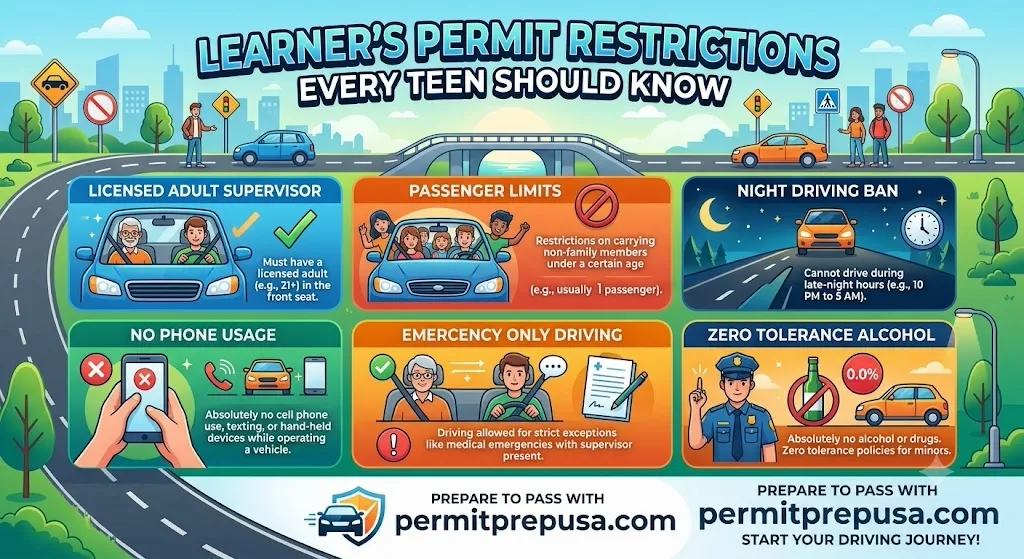
Quick-Answer Box: A learner's permit is highly restrictive. Beyond the absolute mandate that you **cannot drive alone**, teenage permit holders must strictly follow 1) Nighttime Driving Curfews (typically banning driving between 11:00 PM and 5:00 AM), 2) Passenger Limits (restricting non-family occupants under 21), and 3) Absolute Cell Phone Bans (zero-tolerance for hands-free or handheld devices). Violating these rules can trigger hefty fines, court appearances, and an immediate reset of your licensing timeline.
Every year, thousands of teenagers sit at our computerized testing terminals, ace their exams, and walk up to my counter to claim their temporary paperwork. They are thrilled, and they should be. But as a DMV examiner, I often have to act as the bearer of bad news. I look them in the eye and say: "Congratulations on passing, but do not mistake this piece of paper for total freedom."
Many first-time drivers assume that once they get a permit, they can drive anywhere, at any time, with anyone in the car, as long as a parent is somewhere in the vehicle. That assumption is flat wrong. The state views novice drivers as a statistical risk, which is why legislatures created the Graduated Driver Licensing (GDL) framework.
If you break a single GDL restriction, law enforcement will treat it as a serious traffic offense. Let's pull back the curtain on the three most critical restrictions every teen driver must follow, look at how the rules change across different states, and outline the severe administrative penalties that hit your file if you get caught violating them.
Restriction 1: The Nighttime Driving Curfews
Statistically, the most dangerous hours for a novice driver are after dark. Visual acuity drops, fatigue sets in, and the probability of encountering impaired drivers increases exponentially. Because of this risk, almost every state enforces strict nighttime curfews for permit holders under the age of 18.
Many teens believe that curfews only apply to full licenses, but they are heavily enforced during the permit phase. While a licensed adult supervisor must *always* be in the front seat, many jurisdictions strictly prohibit permit holders from operating a vehicle during late-night blocks—usually between 11:00 PM and 5:00 AM or midnight and 5:00 AM.
There are very few legal exceptions to this rule. A police officer will generally only excuse a curfew violation if you can present official documentation proving you are driving directly to or from a school-sanctioned event, a medical emergency, or a verified employment shift. If you are just driving home from a friend's house at 1:00 AM, you will be cited.
Restriction 2: Strict Passenger Limits
Distraction is the number one cause of accidents among teenage drivers. When a vehicle is filled with high school peers, the driver's cognitive focus shifts away from the road. To combat this issue, the DMV enforces strict passenger caps.
The core rule is absolute: your front passenger seat must always be occupied by a qualified, licensed adult supervisor who meets the age metrics we detailed in our guide on can you drive alone with a learner's permit. But what about the back seat?
- In many states, permit holders are forbidden from carrying any passengers under the age of 21 who are not immediate family members (such as brothers or sisters).
- If you want to drive your friends to the mall or a movie, you cannot do so independently on a permit. A qualified adult must still lead the vehicle from the front seat, and some strict jurisdictions bar non-family peers completely during the first few months of training.
State-by-State GDL Restriction Matrix
Because traffic laws are highly regionalized, your exact boundaries depend completely on your zip code. A restriction enforced heavily in New York might be relaxed in a more rural state like Texas.
To help you memorize the local metrics, I have organized the primary GDL parameters for several highly populated jurisdictions into a streamlined reference table.
| State Jurisdiction | Primary GDL Restrictive Parameters |
|---|---|
| California | Strict Curfew & Peer Ban: Cannot drive between 11 PM and 5 AM. No passengers under 20 allowed without a certified adult supervisor present. |
| Texas | Electronic & Curfew Cap: Zero mobile devices allowed (even hands-free). Curfew active from midnight to 5 AM. |
| Florida | Daytime Progressive Shift: Permit holders can only drive during daylight hours for the first 3 months. Later, they can drive until 10:00 PM. |
| New York | Geographical Lockdowns: Incredibly strict. Highly restricted driving hours and locations within NYC and Long Island, even with a permit. |
Restriction 3: Zero-Tolerance Cell Phone Bans
This is the rule that catches the most teenagers off guard. Many young drivers believe that if they use a Bluetooth headset, Apple CarPlay, or a hands-free dashboard mount, they are legally compliant.
Let me clarify the statutory reality: **For permit holders under 18, cell phone bans are absolute and zero-tolerance.**
The law does not care if you are talking to your mom, using voice-to-text, or adjusting your GPS application. If a law enforcement officer sees a mobile device in your hand or detects you actively interacting with a phone screen while operating a vehicle, you will receive an immediate citation. The hands-free loop-holes that apply to adult drivers do not apply to minors in the GDL pipeline.
The Administrative Punishment: Resetting the GDL Clock
If you get pulled over for speeding, running a stop sign, or violating any of the curfews and passenger limits listed above, the fallout is devastating to your timeline.
When you initially qualified for your permit by reaching the age metrics in how old do you have to be to take the permit test, you entered a mandatory holding window (usually 6 to 12 months). A single moving violation ticket or GDL infraction tells our server that you are a reckless operator.
The system will instantly execute an automatic reset script, wiping out your accrued practice months and forcing your holding clock back to zero. You will have to wait an additional six months without a ticket before you can even schedule a behind-the-wheel road test.
Furthermore, if you let your permit expire while serving out a court-ordered suspension or delay, you will have to deal with the exact renewal surcharges and timelines we deconstructed in how long is a learner's permit valid. This includes coming back to my counter, paying a new fee, and retaking the written exam, which means re-facing the entire process outlined in what happens if you fail the DMV permit test.
An Examiner's Blueprint for Passing the GDL Phase
The restrictions placed on your learner's permit are not punishments; they are protective layers designed to keep you alive while your brain builds muscle memory.
Treat your permit phase with absolute professionalism. Keep your mobile device off and stowed in the glovebox, respect the midnight curfews, limit your passengers strictly to immediate family members, and log your hours honestly. If you maintain this disciplined focus, you will easily protect your record, clear the GDL checkpoints, and earn your full, unrestricted driver's license on your very first try.
