The Examiner’s Direct Answer: The Lifespan of a Permit
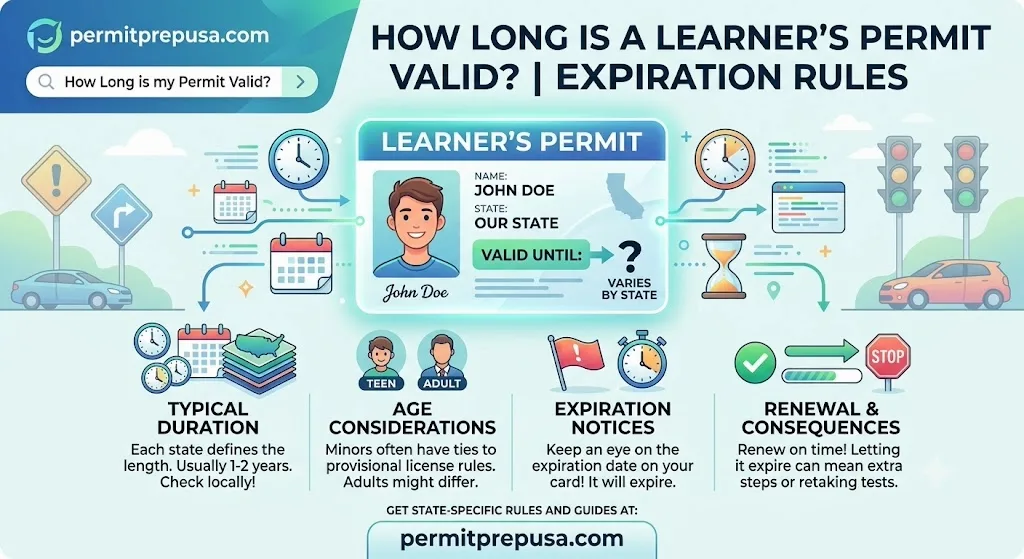
Quick-Answer Box: In the vast majority of U.S. states, a standard learner's permit is valid for exactly 12 months (one full year) from the date it was issued. However, certain states deviate from this standard framework: California permits remain active for 12 months, Texas permits are typically valid for up to six years (matching your age demographic tier), while states like Florida grant a one-year window. If you do not pass your behind-the-wheel road test before this expiration date hits, your permit becomes legally void, and you cannot practice driving.
Every single week, I have to deliver incredibly frustrating news to an applicant standing at my counter. They will hand me their paperwork, ready to finally take their practical, behind-the-wheel road test. I will scan their barcode into our state server, and the screen will immediately flash a bright red administrative warning: "Credential Expired."
When I inform them that their permit expired two days prior, the panic sets in. They assume that because they passed the written kiosk once, their testing credit is good forever. That is a massive misconception.
As a DMV examiner, let me make something very clear: a learner's permit is a temporary training credential, not a permanent license. It carries a strict legal shelf life. If you let the clock run out before you schedule your road test, you cannot simply pay a fee to renew it; our automated systems will force you to face the administrative penalties. Let's look at the operational timeline of permit validity, analyze how rules shift across major states, and outline the exact steps required to extend or renew your file before it is too late.
The Standard 12-Month Clock: Why the DMV Enforces It
The universal baseline for an instructional permit across the United States is one year. The state legislature determines that 12 months is more than enough time for a novice driver to complete their mandatory holding windows, execute their behind-the-wheel practice logs, and clear their local road test schedules.
The reason we don't allow permits to remain active indefinitely comes down to regulatory decay. Traffic laws change, pavement marking guidelines adapt, and statutory fine thresholds are updated by lawmakers regularly. If we allowed an applicant to hold a permit for three or four years without ever graduating to a full license, their theoretical foundation would be completely out of date.
Your one-year clock begins the exact day you clear the terminal gating requirements outlined in what score do you need to pass the DMV permit test and receive your temporary printout. It does not look at when you started your driver education course or when you completed your first practice hour.
State-by-State Validity Variations (Mobile-Friendly Table)
While the one-year standard applies to a massive chunk of the country, state autonomy means expiration matrices vary wildly. Some jurisdictions tie permit validity directly to your age profile, while others offer shorter, high-pressure windows.
To help you monitor your specific countdown, I have organized the administrative timelines for several highly populated states into a maximum two-column reference chart.
| State Jurisdiction | Legal Permit Validity and Lifespan |
|---|---|
| California | Exactly 12 Months: Valid for one year from the date of the application payment. Cannot be extended. |
| Texas | Up to 6 Years: Generous timeline. Typically expires on your next major profile tier birthday (e.g., matching the standard state ID window). |
| Florida | Exactly 1 Year: Class E learner's license is active for 12 months. Surcharges apply if renewed late. |
| New York | Up to 5 Years: An instructional permit is valid for up to 5 years depending on the exact payment structure chosen at entry. |
| Illinois | Exactly 12 Months: Strict one-year window. Must clear the road evaluation before the 365-day mark. |
What Happens the Exact Day Your Permit Expires?
If the expiration date printed on the front of your card passes and you have not cleared your behind-the-wheel examination, your driving privileges instantly drop to zero.
Here is the administrative fallout you face the day after expiration:
- The Practice Ban: You can no longer legally operate a motor vehicle, even if a parent or certified driving school instructor is sitting directly next to you in the passenger seat. If a police officer pulls you over with an expired permit, you will be cited for driving without a valid license, and the vehicle may be impounded on the spot.
- Application Voiding: In strict states like California, your permit expiration doesn't just invalidate the card—it completely deletes your active application file from our network.
- The Written Test Reset: This is the worst penalty. If your application file voids due to expiration, your previous passing score at our computerized kiosk is permanently erased.
To get back behind the wheel, you will be forced to complete the entire clerical process from the very beginning. This means booking a new appointment, bringing your original identity files back to my desk—exactly as we logged in what to bring to your DMV permit test appointment—paying a full-price fee, and taking the written test a second time. If you want to remember what that process feels like, make sure to read our review on how hard is the DMV permit test.
The Renewal Process: Can You Extend the Clock?
If you see your expiration date approaching and you realize you aren't ready for your road test, or you cannot find an open scheduling slot in our portal, you must act **before** the card expires.
Many states allow a streamlined renewal process if your file is still technically alive. For example, you can visit a branch office, fill out a renewal form, pay a minor administrative fee (usually around $10 to $15), and receive a permit extension without having to sit at our testing kiosks again.
However, this extension privilege is typically a one-time allowance. The state will not let you renew a permit indefinitely. If you fail your subsequent road test attempts and exhaust your renewed timeline, our database will trigger the hard reset protocol we detailed in our report on can you retake the DMV permit test if you fail, forcing you back to the written test phase.
An Examiner's Advice for Managing Your Timeline
Time management is a critical component of being a responsible driver. The moment I hand you your temporary paper document at my window, look at the expiration date and map out your calendar immediately.
If your state requires a mandatory six-month holding window, do not wait until month eleven to start practice driving or trying to log your hours. Our booking software is frequently congested, and if you delay, you might not find an open road test date before your credential expires, forcing you to face the administrative penalties mapped out in what happens if you fail the DMV permit test.
Respect the clock, log your behind-the-wheel practice consistently, monitor your permit's expiration text, and ensure you clear your practical evaluation well within your active window.
