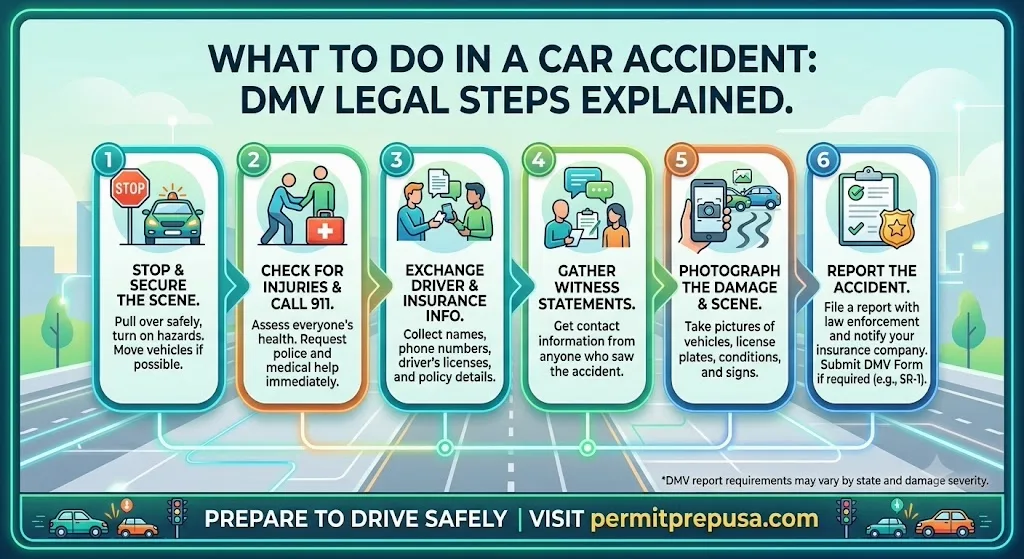
The Examiner’s Direct Answer: The Statutory Protocol
Quick-Answer Box: If you are involved in a car accident, you must legally execute three immediate steps to pass the DMV standards and avoid criminal charges. 1) Stop Immediately: Fleeing the scene of any collision, regardless of fault, is a crime. 2) Secure the Scene: If there are no severe injuries and the vehicles are drivable, you must move them out of the traffic lanes to prevent secondary crashes. 3) Exchange Information: You are legally required to provide your driver's license, vehicle registration, insurance information, and current address to the other involved parties and law enforcement. If the crash involves an unattended vehicle, you must leave a securely attached note with your contact details.
At the DMV, we train drivers to prevent collisions using the hazard perception strategies we mapped out in our masterclass on defensive driving techniques. However, the statistical reality is that the average American driver will be involved in three to four motor vehicle accidents during their lifetime. Because the metal and glass mechanics of a crash are chaotic, the state legislature has established a highly structured, rigid set of legal protocols you must follow the moment your vehicle makes impact.
When you sit down at our computerized testing terminal, the system will evaluate your knowledge of these post-crash procedures. Answering these questions incorrectly indicates to the software that you are a massive liability risk. The state views failing to report a collision or fleeing a scene not as a minor traffic infraction, but as a severe criminal offense that warrants immediate license suspension or jail time.
As a veteran DMV examiner, I have seen perfectly good drivers ruin their permanent records because they panicked after a minor fender-bender and made the wrong legal move. To ensure you protect your driving privilege, pass your written permit test, and survive the stressful aftermath of a collision, we are going to break down the absolute statutory requirements of what to do after a car accident.
Step 1: The Absolute Mandate to Stop (Hit-and-Run Laws)
The most foundational law regarding traffic collisions is simple: You must stop. It does not matter if the accident was your fault, the other driver's fault, or an unavoidable act of nature. It does not matter if the damage appears to be just a minor scratch on the bumper. If your vehicle is physically involved in an incident that causes property damage, injury, or death, you are legally bound to the geographic scene.
If you panic and drive away—even if you plan to call the police later from your house—you have just committed a Hit-and-Run. Depending on the severity of the crash, a hit-and-run can be classified as a major misdemeanor or a felony. A conviction will result in an immediate, mandatory revocation of your driver's license, massive fines, and potential imprisonment. If you are operating on a temporary credential, this will completely obliterate the timeline we discussed in learner's permit restrictions every teen should know.
Step 2: "Steer It and Clear It" (Moving the Vehicles)
A massive misconception among novice drivers is that they must leave their crashed vehicles exactly where they stopped so the police can "investigate the scene." Unless there is a catastrophic injury, a fatality, or the vehicles are mechanically immobilized, leaving your cars blocking high-speed traffic lanes is incredibly dangerous and illegal in most states.
Most jurisdictions strictly enforce a "Steer It and Clear It" or "Fender Bender" law. If you are involved in a minor collision and there are no serious injuries, you are legally required to safely steer your vehicle to the right-hand shoulder, emergency lane, or a nearby parking lot. This prevents secondary, high-speed collisions caused by inattentive drivers crashing into your stopped vehicles, and it keeps the highway flowing for emergency responders.
Step 3: Exchanging Mandatory Information
Once you are safely pulled over, statutory law dictates exactly what information you must share with the other driver. You do not need to debate who is at fault, and the DMV actually recommends that you do not admit fault or apologize at the scene, as this can be used against you in civil court or by insurance adjusters.
You are only required to politely and clearly exchange the following specific data points:
- Driver's License details: Full name, license number, and current physical address.
- Vehicle details: The make, model, year, and the license plate number of the vehicle.
- Vehicle Registration: Proof that the car is legally registered to operate on state roads.
- Insurance Information: The name of your auto insurance provider and the specific policy number.
Step 4: Reporting to Law Enforcement and the DMV
Not every accident requires a police presence, but every accident exceeding a certain financial or physical threshold requires formal reporting. The DMV kiosk will test you on exactly when you are required to notify the authorities.
When to Call the Police
You must call 911 immediately if any of the following conditions are met:
- Anyone is injured or killed, no matter how minor the injury seems.
- One of the involved drivers appears intoxicated or under the influence of drugs.
- The collision results in significant property damage that immobilizes a vehicle in traffic.
- A driver attempts to flee the scene (hit-and-run).
The Independent DMV Crash Report
Here is a major trap on the written test: Many applicants believe that if a police officer arrives and writes a report, the DMV is automatically notified. In many states (like California and Texas), this is false.
If an accident results in injury, death, or property damage exceeding a state-specific monetary threshold (usually between $750 and $1,500), you or your insurance agent must file an independent accident report form directly with the DMV within a specific timeframe (usually 10 days). Failing to file this separate administrative report will trigger an automatic suspension of your driver's license, even if the accident was completely the other person's fault.
Collisions with Unattended Vehicles or Property
What happens if you are pulling into a parking space at a grocery store and you accidentally scrape the side of an empty, parked car? Because the other driver is not there to exchange information, the law outlines a very specific alternative procedure.
You cannot simply drive away; that is still classified as a hit-and-run. You must:
- Make a reasonable effort to locate the owner of the vehicle or property (e.g., asking a store manager).
- If you cannot locate the owner, you must leave a written note in a conspicuous, secure place on the vehicle (usually tucked under the windshield wiper).
- The note must contain your full name, contact phone number, address, and a brief explanation of what happened.
- You must then immediately notify the local police department or highway patrol about the incident.
Accident Response Legal Matrix (Mobile-Friendly Guide)
To help you prepare for the situational questions on the written permit exam, I have structured the legal requirements into a quick-reference table. Commit these administrative actions to memory.
| Crash Scenario | Required Statutory Action |
|---|---|
| Minor Fender-Bender (No Injuries) | Move vehicles out of traffic immediately. Exchange license, registration, and insurance details. |
| Hitting an Unattended Parked Car | Leave a securely attached note with your name and contact info. Report the collision to local police. |
| Accident Involving Injury or Death | Do NOT move the severely injured unless facing imminent danger (fire). Call 911 immediately. Never leave the scene. |
| Damage Exceeds State Threshold (e.g., $1,000+) | Must independently file an official Crash Report Form with the DMV within the mandated timeframe (usually 10 days). |
| Collision with a Domestic Animal (e.g., Dog) | Pull over safely. Try to locate the owner. If unavailable, contact local animal control or police. Do not leave the injured animal in traffic. |
Financial Responsibility: The SR-22 Consequence
If you are involved in a reportable collision and you do not possess valid auto insurance at the exact moment of the crash, the DMV will ruthlessly penalize you. Driving without insurance is illegal in almost every state.
If the DMV discovers you were uninsured during a crash, your driving privileges will be suspended for up to four years. To ever get your license back, you will be legally required to file an SR-22 Certificate of Financial Responsibility. This is a special document your insurance company files directly with the DMV, proving you are maintaining high-risk insurance coverage. Carrying an SR-22 mandate will cause your monthly insurance premiums to skyrocket, completely devastating your finances for years.
An Examiner's Final Warning on Post-Crash Protocol
When you sit down to take your DMV permit test, the examiner software wants to see that you understand the grave responsibility of operating a motor vehicle. A crash is the ultimate test of your administrative knowledge.
Remember the golden rules: Never flee the scene, move your vehicle out of the flow of high-speed traffic if there are no injuries, and always report severe damage directly to the DMV, even if the police were present. If you respect these protocols, you will not only ace the accident-related questions on your written exam, but you will also protect yourself from severe criminal liability out on the real asphalt.
