The Examiner’s Direct Answer: Can You Make an Exception?
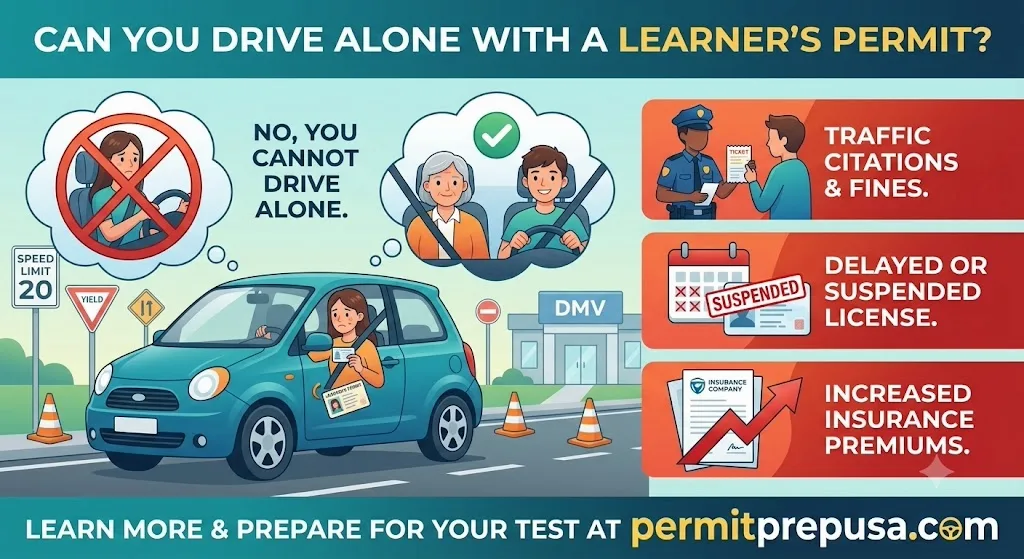
Quick-Answer Box: Absolutely not. You **cannot drive alone under any circumstances** if you only hold a learner's permit. A permit is not an independent driver's license; it is a restrictive legal document that only authorizes you to practice driving under the immediate supervision of a licensed adult passenger. If you are caught driving alone, you will face severe statutory penalties, including criminal or civil traffic citations, heavy fines, vehicle impoundment, and an immediate suspension of your driving privileges.
It happens at least once a month at my DMV branch. A local police officer walks through our front doors carrying a confiscated temporary paper permit and a stack of citation paperwork. Behind him walks a terrified teenager and an incredibly angry parent. The teen got caught driving alone to school or the grocery store, assuming that because they passed their written kiosk, they were "basically a licensed driver."
Let me disabuse you of that dangerous notion immediately: passing the written knowledge test does not mean the state trusts you to operate a 4,000-pound motor vehicle independently on public roads. The written test merely proves you understand the concepts; it does not verify your practical execution.
As a DMV examiner, I can tell you that driving alone with a permit is one of the quickest ways to permanently ruin your driving record before your career even begins. Let's deconstruct the strict legal passenger requirements, examine the immediate real-world penalties of getting pulled over alone, and outline how a single solo trip can completely reset your licensing timeline.
The Strict Passenger Mandate: Who Must Sit Next to You?
The core legal definition of a learner's permit—regardless of whether you are in California, Texas, or Florida—is that it is a *supervised* credential. Statutory law dictates that whenever you are in the driver's seat, a fully licensed driver must occupy the front passenger seat directly next to you.
This supervisor cannot be sitting in the back seat, they cannot be asleep, and they cannot be impaired by alcohol or drugs. They are legally considered the "operator in command" of the vehicle and are there to assist you, grab the steering wheel in an emergency, or instruct you through dangerous traffic patterns.
Furthermore, you cannot just pick any friend who has a license. Most states enforce strict age thresholds for this supervising passenger:
- In many jurisdictions, the supervisor must be a parent, legal guardian, or a licensed driver who is at least 21 years old.
- In stricter states like California or Ohio, that front-seat licensed passenger must be 25 years old or older.
- The supervisor's license must be active and completely valid. If your parent's license is currently suspended for a medical or legal reason, they cannot legally supervise your permit driving.
The Legal Fallout: What Happens If You Get Pulled Over Alone?
If a law enforcement officer pulls you over and you cannot present a licensed adult in the front passenger seat, the officer will not look at your permit as an excuse. They will treat you exactly the same as an individual driving with no license at all.
The legal consequences are immediate, severe, and highly bureaucratic:
- Criminal or Misdemeanor Surcharges: In many states, driving alone with a permit is classified as a misdemeanor offense (often cited as "Driving Without a Valid License"). This is a criminal charge that requires a mandatory court appearance.
- Substantial Monetary Fines: Depending on your jurisdiction, the baseline fine for a solo permit violation ranges from $200 to over $1,000, excluding court costs and administrative surcharges.
- Immediate Vehicle Impoundment: Because you cannot legally drive the car away from the scene and there is no licensed supervisor present to take the keys, the police officer will call a tow truck. Your car will be impounded on the spot, forcing your parents to pay hundreds of dollars in towing and storage fees to recover it.
The Timeline Reset: How a Solo Trip Destroys Your Progress
Beyond the immediate financial pain, the administrative penalties inside the DMV database will completely derail your driving timeline.
Under the Graduated Driver Licensing (GDL) framework, minors must hold their permit for a continuous, clean period (usually six consecutive months). If you commit a moving violation or get caught driving alone, that clock does not just pause—the system executes a hard administrative reset.
To see exactly how a single unforced error impacts your standing across major populations, I have formatted the advanced GDL penalty metrics into a clean, mobile-optimized reference chart.
| Violation Type | Immediate Administrative DMV Penalty |
|---|---|
| First Solo Permit Offense | The Clock Resets to Zero: Your mandatory 6 or 12-month holding period is completely wiped out. You must hold the permit for a brand-new consecutive window without violations before booking a road test. |
| License Suspension | Mandatory Delay: The system can flag your profile, preventing you from applying for a full provisional or intermediate driver's license until you turn 18 or serve a 90-day suspension window. |
| Insurance Spike | Long-Term Financial Drain: A citation for driving without a license flags you as a "High-Risk Driver." Your family's auto insurance premiums can surge by 50% or more for up to three years. |
If you think you can simply bypass the physical paperwork and hide the ticket from our agency, you are mistaken. The court system automatically links the citation back to your unique applicant ID, matching the profile data established when you submitted your files under what to bring to your DMV permit test appointment.
Exceptions to the Rule: Are There Any?
Applicants frequently try to find loopholes in our office regulations. They will ask me if they can drive alone if it is a medical emergency, if they are driving straight to a school event, or if they are operating a moped or motorcycle.
Let me give you the absolute truth from behind the counter: **There are zero exceptions for passenger vehicles.**
The law does not care if your high school is only two blocks away, and it does not care if you were simply moving the car across a public street to avoid a parking ticket. The only legal variant is if you hold a specific motorcycle learner's permit, which carries its own unique daytime operational boundaries, but for a standard Class C or Class E passenger vehicle, the supervised passenger rule is absolute 24/7.
If your permit expires while you are waiting out a court-mandated penalty window or a GDL delay script, you will face the full financial and logistical renewal burdens we broke down in our guide evaluating how long is a learner's permit valid. You may even be forced to sit at our computerized kiosks to take the written test all over again, forcing you to re-study the parameters of how hard is the DMV permit test.
An Examiner's Final Warning on Solo Driving
The desire for independence is completely natural. The entire reason you spent hours studying the manual, managing your score buffer, and passing the written exam—as outlined in our breakdown on what score do you need to pass the DMV permit test—was to unlock the freedom of the open road.
But trying to shortcut the process by driving alone is an act of extreme arrogance that carries massive legal risks. If you are caught, you don't just delay your freedom—you invite criminal charges, drain your bank account, and break the trust of our licensing agency.
Respect the GDL process. Keep an approved, sober, licensed adult in your front passenger seat at all times, log your behind-the-wheel hours honestly, and you will quickly graduate to the phase where you can safely and legally drive alone.
